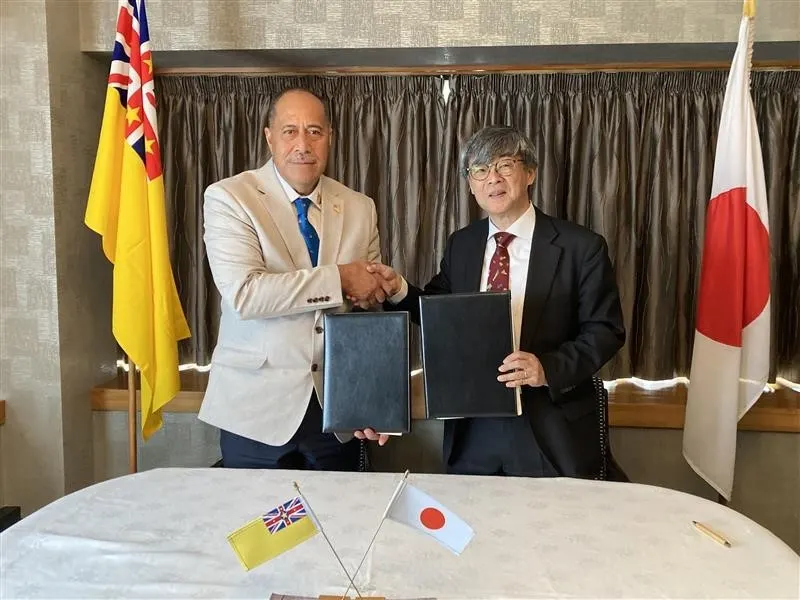
On November 11, 2025, in Wellington, New Zealand, Makoto Osawa, Ambassador Extraordinary and Plenipotentiary of Japan to Niue, and Dalton Emani Makamau Tagelagi, Prime Minister of Niue, signed and exchanged notes concerning the Economic and Social Development Programme aimed at strengthening disaster response capability in Niue. The project involves support up to 140 million yen.
This initiative focuses on enhancing disaster preparedness in Niue through the provision of Japanese-manufactured equipment, including wheel loaders and excavators. It is designed to support the economic and social development of Niue.
Connection to Regional Commitments
The cooperation aligns with the Leaders Declaration and the Joint Action Plan from the 10th Pacific Islands Leaders Meeting, known as PALM 10, which took place on July 18, 2024. In these documents, Japan identified Climate Change and Disasters as a key priority area for its assistance efforts.
Diplomatic Milestone
The year 2025 marks the 10th anniversary of the establishment of diplomatic relations between Japan and Niue. The implementation of this project is anticipated to further solidify the friendly ties between the two nations.
Background on Niue
Niue covers a land area of about 259 square kilometers and has a population of 1,673 people, according to 2023 data from the Asian Development Bank.
Details of PALM 10
The 10th Pacific Islands Leaders Meeting occurred from July 16 to 18, 2024, and was co-chaired by Prime Minister Kishida of Japan and Prime Minister Brown of the Cook Islands, who served as the Chair of the Pacific Islands Forum. The event brought together leaders and representatives from 19 countries, regions, and one regional organization, including Japan, 14 Pacific Island countries, two French overseas collectivities, Australia, New Zealand, and the Pacific Islands Forum chair. Dalton Tagelagi attended on behalf of Niue.
During the meeting, Japan outlined its plans to maintain strong development assistance and facilitate more than 6,500 people-to-people exchanges, along with human resource development, over the next three years. These efforts are structured around seven priority areas that correspond with the 2050 Strategy for the Blue Pacific Continent of the Pacific Islands Forum: Political Leadership and Regionalism, People-centered Development, Peace and Security, Resources and Economic Development, Climate Change and Disasters, Ocean and Environment, and Technology and Connectivity.