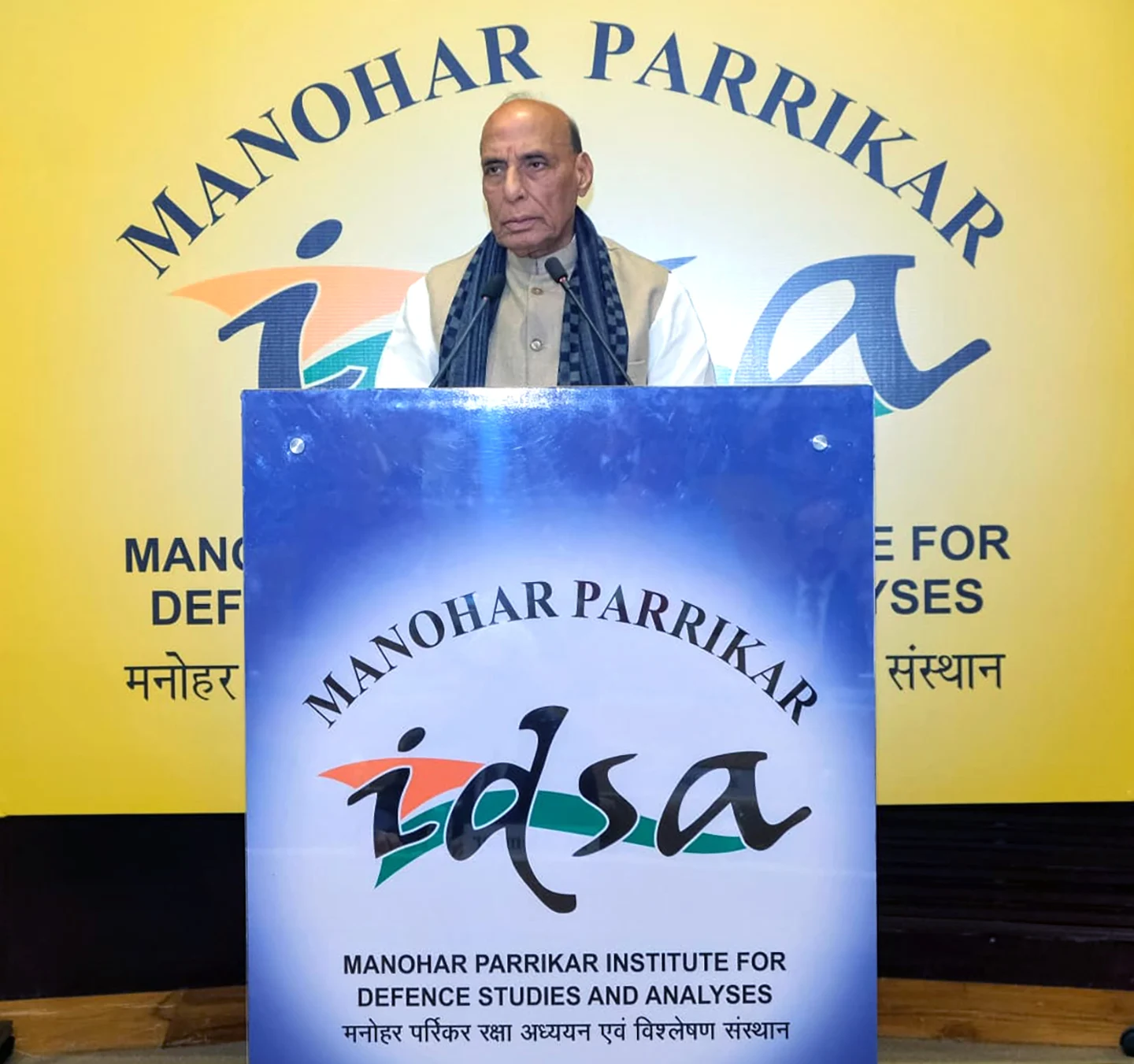
New Delhi, November 11, 2025: For India to transition from being a consumer to a creator of technology, Raksha Mantri Shri Rajnath Singh emphasized the need to foster environments where niche defence technologies can flourish through strong processes, agile institutions, and collaborative efforts among soldiers, scientists, start-ups, and strategists. He delivered the inaugural address at the Delhi Defence Dialogue, organized by the Manohar Parrikar Institute for Defence Studies and Analyses (MP-IDSA), under the theme ‘Harnessing New Age Technology for Defence Capability Development’.
Building Ecosystems for Seamless Technology Adoption
Shri Rajnath Singh called for systems and ecosystems that enable the creation and adoption of new technologies to be natural, rapid, and self-sustaining. “If our foundations are strong, our institutions agile, our minds open, and our collaboration seamless, then every new technological wave will not overwhelm us. It will propel us. We will not merely adapt to revolutions made elsewhere, but become the architects of revolutions born here,” he said.
He stressed absorbing and adapting to disruptive technologies such as Artificial Intelligence (AI), Machine Learning, Quantum Computing, and Swarm Technology. He added that the true measure of advancement lies in how institutions and processes function. “The power of technology lies in its all-encompassing nature – the way it redefines every process, system, and decision that contributes to national security,” he stated.
Leveraging Invisible Technologies for Defence Readiness
The Raksha Mantri highlighted that high-speed data links, AI-driven algorithms, quantum computing, and autonomous systems achieve their full potential only when supported by robust internal processes and human capacity. He pointed out the importance of ‘invisible technologies’ such as secure data architectures, encrypted networks, automated maintenance systems, and interoperable databases.
Expanding India’s Defence Industrial Base
Shri Rajnath Singh noted that the defence industrial base is growing with confidence, with synergy among DRDO, the Armed Forces, industry, and academia creating a virtuous cycle of research, testing, field feedback, and innovation. “India can no longer be content with merely catching up to global innovation. We must continue nurturing a culture of innovation by encouraging collaboration over silos and speed over procedural inertia,” he said.
Promoting Innovation through iDEX and TDF
The Raksha Mantri mentioned initiatives like Innovations for Defence Excellence (iDEX) and the Technology Development Fund (TDF), which nurture innovators committed to national defence. “From young entrepreneurs and MSMEs to captains of Indian multinationals, individuals and companies have shown the collective will to achieve the mission of Viksit Bharat and Aatmanirbharta,” he said.
Extending Aatmanirbharta to Digital Sovereignty
Shri Rajnath Singh emphasized that strategic autonomy requires not only indigenous hardware but also control over algorithms, data, and chips powering platforms. “True strategic autonomy will come only when our code is as indigenous as our hardware. We are encouraging secure, indigenous software stacks, trusted semiconductor supply chains, and home-grown AI models trained on Indian data,” he said.
He further stressed that technology should enhance human judgment and underscored the ethical, psychological, and legal dimensions of emerging technologies. “India, as a civilizational power, can and must lead the conversation on responsible and humane use of military technology,” he added.
Optimizing Defence Procurement
Shri Rajnath Singh urged leveraging technology and data analytics in capital procurement to ensure optimal use of resources. “In many advanced nations, the concept of life-cycle cost is deeply woven into procurement frameworks. We must begin assessing these sustenance costs from the inception stage of every procurement proposal,” he said.
Learning from Global Best Practices
The Raksha Mantri encouraged the Armed Forces to study best global practices not only in equipment but also in training, logistics, planning, and management. “It is better to import best practices than to import the best equipment. Once our processes and systems are robust, adaptive, and transparent, we can produce excellence at home,” he said.
Condolences and Justice for Delhi Tragedy Victims
Shri Rajnath Singh began his address by expressing condolences to the victims of the Delhi accident on November 10, 2025. He assured that the nation’s investigative agencies are conducting a thorough inquiry and that those responsible will be brought to justice without exception.
Attendance
Chief of Defence Staff General Anil Chauhan, DG MP-IDSA Ambassador Sujan Chinoy, ambassadors from friendly nations, and civil and military officials were present at the event.