Stage-III of GRAP Invoked in Delhi-NCR Amid Severe Air Quality Deterioration
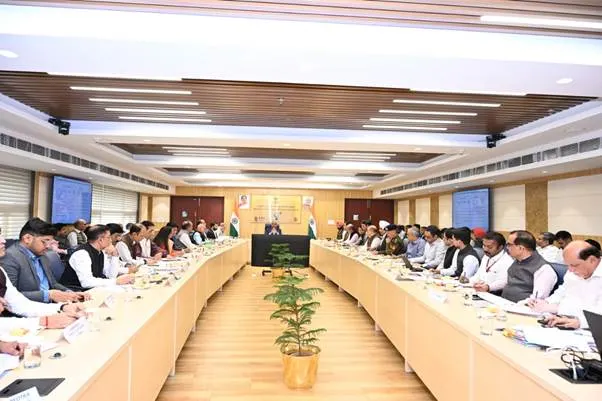
The Commission for Air Quality Management in National Capital Region and Adjoining Areas (CAQM) Sub-Committee reviewed the deteriorating air-quality scenario in the National Capital Region (NCR). With Delhi’s average Air Quality Index (AQI) reaching 425 at 9 AM, calm winds, a stable atmosphere and unfavourable meteorological conditions triggered immediate action.
The Sub-Committee invoked the nine-point action plan corresponding to **Stage-III** of the extant Graded Response Action Plan (GRAP) — for ‘Severe’ air quality (AQI between 401-450) — in the entire NCR, in addition to Stages I and II already in force.
The action plan includes:
- **Construction & Demolition (C&D) activities**:
- Strict restrictions on earth-work for excavation/filling, boring & drilling, piling, all demolition, open-trench laying of sewer/water/drain/electric cables, brick/masonry works, operation of RMC batching plants, major welding/gas-cutting, painting/polishing/varnishing, cutting/grinding/fixing of flooring materials (except minor indoor repairs), road construction or major repairs, transfer/loading/unloading of dust-generating materials, vehicle movement on unpaved roads, transportation of demolition waste.
- Other construction activities less polluting or less dust generating may continue—but subject to strict compliance with C&D Waste Management Rules, dust-prevention norms and directions of the Commission.
- Even the restricted C&D activities may continue only for certain project categories: railway services and stations; metro rail services and stations; airports and interstate bus terminals; national-security/defence projects of national importance; hospitals/health-care facilities; linear public projects (highways, roads, flyovers, power-transmission/distribution, pipelines, tele-communication services); sanitation projects (sewage treatment, water-supply); ancillary activities supporting the above project categories.
- Shut down stone-crushers in the entire NCR.
- Shut down all mining and associated activities in the entire NCR.
- State governments of the NCR and Government of NCT of Delhi (GNCTD) to impose strict restrictions on plying of BS-III petrol and BS-IV diesel light-motor vehicles (4-wheelers) in Delhi and districts of Gurugram, Faridabad, Ghaziabad and Gautam Buddh Nagar. Persons with disabilities (PwDs) will be permitted BS-III petrol/BS-IV diesel LMVs if specially adapted and used only for personal use.
- GNCTD to impose strict restrictions on Delhi-registered BS-IV diesel-operated medium-goods vehicles (MGVs) registered at BS-IV standard or below, except those carrying essential commodities or providing essential services.
- GNCTD to prohibit BS-IV diesel-operated light commercial vehicles (goods carriers) registered outside Delhi from entering Delhi, except those carrying essential commodities or providing essential services.
- (i) State governments in the NCR and GNCTD to mandatorily conduct classes for students up to Class V in a “hybrid” mode (physical + online) in Delhi and districts of Gurugram, Faridabad, Ghaziabad and Gautam Buddh Nagar.
(ii) NCR State Governments may also consider hybrid mode up to Class V in other NCR areas.
Note: The option to choose online mode rests with students and their guardians. - (i) GNCTD and NCR State Governments to stagger timings for public offices and municipal bodies in Delhi and the four specified districts.
(ii) State Governments may also stagger timings for public offices/municipal bodies in other NCR areas. - The Central Government may decide on staggering of timings for Central Government offices in Delhi-NCR.
Citizens are urged to cooperate in implementing GRAP. Additional advice: walk or cycle short distances; use cleaner commute modes; share rides or use public transport; where feasible work from home; avoid coal or wood for heating; combine errands to reduce trips; individual house-owners may provide electric heaters for security/staff to avoid open burning of biomass/wood/MSW. The Sub-Committee will keep a close watch and review based on AQI and forecasts. Complete details of the extant GRAP schedule are available on the Commission’s website.
India Reaffirms Equity, Climate Justice and Multilateralism at CoP30, Belém
India delivered statements on behalf of both the BASIC (Brazil, South Africa, India and China) group and the Like‑Minded Developing Countries (LMDC) group at the opening plenary of COP30 in Belém, Brazil. It emphasised the central importance of equity, the principle of common but differentiated responsibilities and respective capabilities (CBDR-RC), and full and effective implementation of the Kyoto Protocol, the Paris Agreement and the United Nations Framework Convention on Climate Change (UNFCCC).
India expressed full support for multilateralism and international cooperation on climate action, acknowledging the extensive preparations made by the Brazilian Presidency of COP30.
In the statement India called for:
* A clear, universally agreed definition of climate finance.
* Strengthened and scaled up public finance flows for adaptation, noting that adaptation financing needs to exceed nearly fifteen times current flows.
* Implementation of Article 9.1 of the Paris Agreement, reaffirming the legal obligation of developed countries to provide finance to developing countries.
India also underlined that the Global Goal on Adaptation (GGA) should produce a minimum package of indicators, while allowing flexibility for countries in accordance with their national circumstances. Further, it supported the UAE–Belém Work Programme and the launch of the Baku Adaptation Roadmap to ensure no one is left behind.
On technology, India stressed that reliable, affordable and equitable access must be a right, not a bargaining tool. It emphasised that intellectual property and market barriers must not hinder transfer of climate technologies to developing nations.
Regarding just transitions, the country called for action-oriented institutional arrangements that ensure transitions are rooted in equity and justice, narrowing the development gap between North and South and leaving no section of society behind.
India warned that unilateral climate-related trade measures risk undermining multilateral cooperation and contradict Article 3.5 of the Convention. The statements reaffirmed that the architecture of the Paris Agreement must not be altered and that the principle of CBDR-RC remains the cornerstone of the global climate regime.
Speaking on behalf of BASIC and LMDC, India recalled the historical and ongoing responsibility of developed nations: they must reach net-zero earlier, invest more in negative emissions technologies and fulfil obligations on finance, technology transfer and capacity-building to developing countries. The statements reaffirmed India’s commitment to constructive and collaborative engagement to ensure a successful and balanced outcome at COP30 in the interests of humanity and the Earth.
Three-Day Himalayan Conclave to Chart Strategy for Indian Himalayan Region by 2047
The G.B. Pant National Institute of Himalayan Environment (NIHE), an autonomous institute under the Ministry of Environment, Forest and Climate Change, will host a three-day Himalayan Conclave titled ‘Indian Himalayan Region – 2047: Environmental Conservation with Sustainable Socio-Economic Growth’ from 13 to 15 November 2025 at its headquarters in Kosi-Katarmal, Almora, Uttarakhand.
The event aims to develop a strategic vision for the Indian Himalayan Region (IHR) by 2047 in alignment with India’s “Viksit Bharat 2047” vision of transforming into a developed and sustainable economy.
Participants will include leading scientists, academicians, policymakers, administrators, NGOs and mountain-region communities. The IHR covers 11 states and two Union Territories and is facing serious challenges including climate change, glacier retreat, flash floods, water-resource depletion and demographic shifts.
The conclave will focus on six major thematic areas, across 21 sessions:
* Himalayan biodiversity under changing climate;
* Land, water and atmosphere interactions;
* Environmental sustainability and climate actions for resilience building;
* Socio-economic development and sustainable livelihood in the IHR;
* Policy and governance frameworks to strengthen regional cooperation;
* Gender equality and social inclusion for sustainable development.
The outcomes are expected to include a revised Himalayan Action Plan and strengthen strategies for climate resilience, sustainable livelihoods, green economy, ecosystem-based climate strategies, responsible tourism, mountain-community empowerment and regional cooperation mechanisms.
The event is co-hosted by the United Nations Development Programme (UNDP) in collaboration with several national and international partners including DST, ICIMOD, IUCN, IIT Roorkee, NIDM, NCSCM, WISA, UCOST, SBI and relevant universities and NGOs.
Union Environment Minister Reviews NCR Air Pollution; Demands Action-Taken Reports from States
Bhupender Yadav, Union Minister for Environment, Forests and Climate Change, chaired a high-level review meeting on air pollution in the Delhi-NCR region. He asked all concerned State/UT authorities to submit concrete action-taken reports regarding efforts in their jurisdictions. This was the fourth such review meeting. The meeting was attended by Manjinder Singh Sirsa, Cabinet Minister for Environment, Forest and Wildlife, Government of NCT of Delhi.
Minister Yadav requested district-wise plans for crop-residue management (CRM); year-round monitoring of stubble-burning; training and capacity building of farmers to operate CRM machines and ensuring widespread machine access. He stressed zero-tolerance for open burning of municipal solid waste (MSW) and asked municipal authorities of NCR cities to prepare strict timelines to address legacy waste-management gaps through accelerated measures.
He directed mission-mode installation of Online Continuous Emission Monitoring Systems (OCEMS) and Air Pollution Control Devices (APCDs) in red-category industries in Delhi-NCR. In order to minimise road dust, he reviewed road-redevelopment roadmaps for identified urban/industrialised areas and asked for timely, quality road-construction completion. He urged roadside greening on a mission-mode basis: municipal corporations to develop saplings in coordination with forest departments, plant them widely on degraded forest lands and boost green cover. The Delhi Traffic Police was tasked to prepare traffic-management plans for identified congestion hotspots and expedite implementation of Intelligent Traffic Management System (ITMS) to minimise vehicular pollution from jams.
The minister reiterated the government’s commitment to improving air quality through coordinated action and stakeholder collaboration.
NBA Releases Patent-Linked Access & Benefit Sharing Funds of ₹43.22 Lakh to Claimers
The National Biodiversity Authority (NBA) has released patent-linked Access and Benefit Sharing (ABS) funds amounting to ₹43.22 lakh for the first time. The funds were generated from intellectual-property rights (IPR) applications that made commercial use of Indian biological resources. This marks a major initiative to ensure equitable sharing of benefits with communities, knowledge-holders and custodians of biological resources.
The funds were disbursed to sixteen State Biodiversity Boards (SBBs), namely: Andhra Pradesh, Chhattisgarh, Goa, Gujarat, Jharkhand, Karnataka, Kerala, Madhya Pradesh, Maharashtra, Odisha, Punjab, Tamil Nadu, Telangana, Uttar Pradesh, Uttarakhand and West Bengal — to be released onward to benefit claimers.
Major recipients include:
| State Biodiversity Board (SBB) | ABS Amount (₹) |
|---|---|
| Andhra Pradesh SBB | 20,66,553 |
| Tamil Nadu SBB | 16,79,482 |
| Odisha SBB | 2,09,965 |
| Uttar Pradesh SBB | 91,500 |
| Madhya Pradesh SBB | 79,547 |
Once transferred to respective Biodiversity Management Committees (BMCs), the funds will support biodiversity conservation, sustainable resource management and community-based livelihood strengthening. Activities may include creation and updating of People’s Biodiversity Registers (PBRs), documentation of traditional knowledge, and other local conservation initiatives. This milestone underscores India’s commitment to fair and equitable sharing under the Nagoya Protocol, while strengthening grassroots-level biodiversity governance nationwide.