Union Agriculture Minister Shri Shivraj Singh Chouhan Visits Punjab and Interacts with Farmers in Ransih Kalan Village
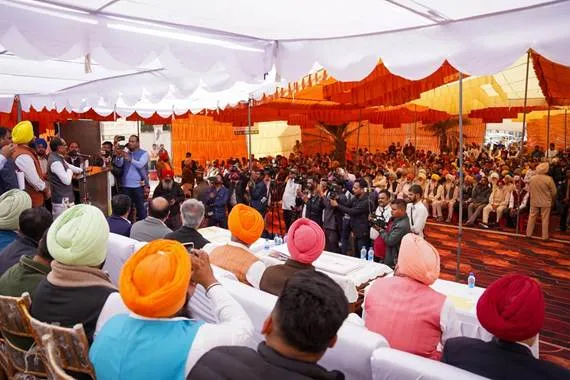
Union Minister for Agriculture & Farmers’ Welfare and Rural Development, Shri Shivraj Singh Chouhan, undertook a one-day visit to Punjab and met farmers, villagers and stakeholders in Ransih Kalan village in Moga. He praised the village for its achievement of avoiding stubble burning for the past six years and commended its approach to stubble management, extending his congratulations to all.
Remarks on Stubble Burning and Field Management
Before attending the main programme, the Union Minister addressed the media and noted that the issue of stubble burning had concerned the entire country. He said that although burning stubble clears fields, it damages beneficial insects and leads to pollution. He stated that he had arrived to acknowledge Punjab’s contribution and to promote the state’s stubble management model across the country. According to him, stubble burning incidents in Punjab had decreased by 83 per cent this year, reducing from nearly 83,000 earlier to about 5,000.
The Union Minister said that many farmers question how to prepare fields for wheat and other crops without burning stubble. He explained that Ransih Kalan had demonstrated a practical solution. For six years, stubble had not been burned in the village. Instead, farmers had been mixing stubble back into the soil and using direct seeding.
Observations During the Main Programme
Addressing the gathering, Shri Chouhan said that he had recently learned about the village’s initiatives. He noted that the community had regarded stubble as a valuable resource rather than a burden. He added that he considered it important to visit farmers directly, as such engagement was necessary to work effectively for their welfare.
He said that conventional practices require water to be applied after burning stubble before preparing land for sowing. However, by following the village’s method, harvesting could be carried out with a Happy Seeder and stubble could be mixed into the soil, allowing direct seeding without water. This approach, he said, saves water and diesel. He noted that stubble contains potash, which enriches the soil. Weed growth is reduced, soil moisture is maintained and organic carbon levels increase, lowering the need for fertilisers. He added that the village sarpanch informed him that fertiliser requirements had decreased from one and a half bags of DAP to one bag and from three bags of urea to two bags, indicating cost savings.
The Union Minister said that mixing stubble into the soil had not affected crop quality or yield, which remained around 20 to 22 quintals per acre. He added that this method was also helpful in potato farming. A farmer informed him that earlier potash had to be applied in potato fields, but now stubble fulfilled the requirement for zinc and potash, leading to larger potatoes, better quality and lower costs.
Shri Chouhan said he also visited mustard fields where similar benefits of stubble cutting and soil incorporation were observed. He stated that farmers could increase returns in mustard cultivation with reduced use of fertilisers and water while improving productivity.
Village Initiatives and Broader Plans
The Union Minister described Ransih Kalan as a school of learning. Under the leadership of the sarpanch, the village had carried out several initiatives including efficient use of leftover water in bottles, rainwater harvesting, plastic management and the development of lakes, parks and a library. He highlighted the village’s anti-drug campaign and noted that underground drainage had helped avoid dengue and malaria. He praised Sarpanch Preet Inderpal Singh Mintu for the work done in these areas.
Shri Chouhan said that he wished to send a message from Ransih Kalan to farmers across the country to adopt this model of stubble management to reduce pollution and improve soil productivity. He stated that he planned to meet selected farmers to exchange ideas and prepare five-year agricultural plans under the leadership of Prime Minister Shri Narendra Modi. He said that a brainstorming meeting on this had been proposed for December 22 to 23, and similar efforts would be undertaken in rural development as well.
The Union Minister said that requests also come from small farmers regarding machinery purchase. He said that he had directed the Director General of the Indian Council of Agricultural Research, Dr. M. L. Jat, to ensure that Custom Hiring Centres also function as mechanisation centres. He added that not all farmers could buy machines, so systems must be created through which machinery could be used collectively or hired as needed.
Discussion on Pulses and Procurement
Shri Chouhan discussed the Self-Reliance in Pulses Mission and said that the government was working to raise pulse production. He said the government would provide subsidies for setting up dal mills in pulse-growing areas. He added that wheat and paddy procurement had been ongoing and would continue. He said the government would also procure lentil, pigeon pea, black gram and chickpea at MSP in whatever quantity farmers produce, ensuring full value for their labour.
The Union Minister said that Punjab was a centre of knowledge and that one felt encouraged to visit again. He said that Punjab had contributed greatly to agriculture and that, under the leadership of the Prime Minister, every possible effort would be made for the state’s development.
“`html