India & Germany Advance Collaboration on Traditional Medicine at the 3rd Joint Working Group Meeting on Alternative Medicine in Berlin
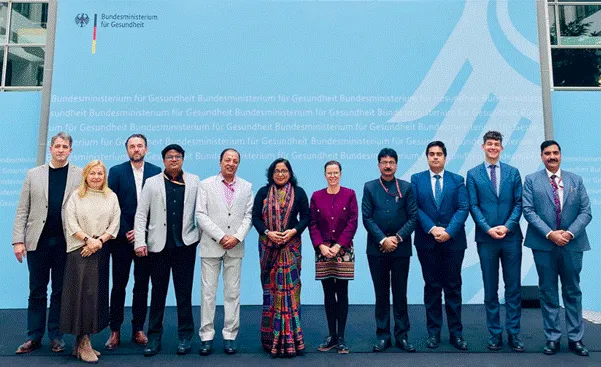
Strengthening collaboration on integration, reimbursement pathways, and regulatory frameworks for traditional medicine
The 3rd Joint Working Group (JWG) Meeting on Alternative Medicine between the Ministry of Ayush, Government of India, and the Federal Ministry of Health, Germany, was held from 18 to 20 November 2025 in Berlin, marking another significant step in advancing Indo-German cooperation in the field of traditional and integrative healthcare.
Indian Delegation
The Indian delegation was led by Ms. Monalisha Dash, Joint Secretary, Ministry of Ayush, and included Prof. (Dr.) Rabinarayan Acharya, Director General, CCRAS; Dr. Subhash Kaushik, Director General, CCRH; Dr. Koustabha Upadhyay, Adviser, Ministry of Ayush; and Dr. Kashinath Samagandi, Director, MDNY. The delegation engaged with leading German institutions to further concrete avenues of collaboration. The German officials leading the programme included Paul Zubeil, Head of Division European and International Health Policy, German Ministry of Health, Prof. Dr. med. Georg Seifert, Head of Competence Center for Traditional and Integrative Medicine, Charité Berlin, Andrea Galle, CEO, BKK mkk (statutory health insurance fund), Dr. Jaqueline Wiesner, Head of Department for Vitamins, minerals, special therapeutic approaches, Federal Institute for Drugs and Medical Devices (BfArM) participated.
Discussion Pillars
The discussions centred on three key pillars—integrating traditional medicine into public health systems, establishing reimbursement pathways for patient access, and strengthening regulatory approval mechanisms. These themes reflect the shared commitment of both nations to foster evidence-based and people-centred traditional medicine practices.
Key Engagements of the Visit
- Competence Center for Traditional and Integrative Medicine, Charité University, to explore collaborative research opportunities and advance the proposed MoU with the Ministry of Ayush.
- Community Hospital Havelhöhe – Clinic for Anthroposophic Medicine, reviewing integrative care and research practices.
- Federal Joint Committee (G-BA) for detailed discussions on insurance and reimbursement mechanisms relevant to traditional medicine.
The mission reflects the Ministry of Ayush’s strategic efforts to globalise Ayush systems, create robust frameworks for evidence-based integration, and strengthen high-value international partnerships that enhance India’s footprint in the global traditional medicine landscape.
The Ministry of Ayush affirmed that sustained collaboration with Germany will help accelerate research, regulatory harmonisation, and patient access to integrative healthcare solutions rooted in safety, quality, and scientific validation.