QCI and BHEL Host Inter PSU Gunvatta Manthan for Operational Excellence
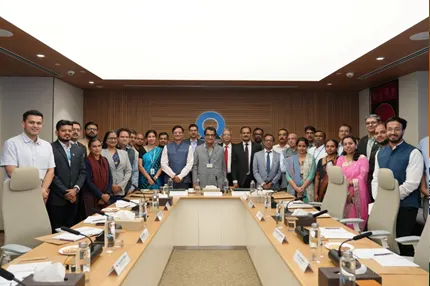
The Quality Council of India (QCI), in collaboration with Bharat Heavy Electricals Limited (BHEL), organised the Inter PSU Gunvatta Manthan in New Delhi to promote quality and operational excellence across Central Public Sector Enterprises (CPSEs).
The event brought together PSUs including BEL, BPCL, EIL, GAIL, IOCL, PGCIL, and THDC to share best practices in Six Sigma, Lean, Total Productive Maintenance, Quality Circles, and digital transformation. It served as a platform for benchmarking quality initiatives and strengthening collaboration among PSUs.
Chairperson QCI Shri Jaxay Shah reaffirmed QCI’s commitment to advancing the national quality movement and fostering globally competitive institutions. Director (R&D) BHEL Shri S. M. Ramanathan emphasized the role of PSUs in socio-economic development and called for efficiency from design to delivery. Chairperson NABCB Dr. Ravi P. Singh highlighted the importance of robust conformity assessment systems to enhance global credibility of Indian quality standards.
The session concluded with QCI and BHEL outlining collaborative models for institutional quality partnerships and maturity enhancement programmes, reinforcing the collective goal of building a culture of quality-driven governance within India’s public sector.
Cabinet Approves Rs.25,060 Crore Export Promotion Mission
The Union Cabinet chaired by Prime Minister Shri Narendra Modi has approved the Export Promotion Mission (EPM) with an outlay of Rs.25,060 crore for the period 2025–26 to 2030–31. The mission aims to strengthen India’s export ecosystem, particularly benefiting MSMEs, first-time exporters, and labour-intensive industries.
The EPM represents a unified and flexible framework that consolidates existing export schemes into a single, outcome-based mechanism. It will address critical challenges such as limited access to trade finance, high compliance costs, weak export branding, and logistical constraints faced by exporters in remote regions.
The Mission will operate through two sub-schemes — NIRYAT PROTSAHAN and NIRYAT DISHA. NIRYAT PROTSAHAN will improve access to affordable trade finance through interest subvention, export factoring, collateral guarantees, and credit enhancement facilities. NIRYAT DISHA will strengthen non-financial enablers including export quality, compliance assistance, international branding, logistics, and capacity-building initiatives.
The Directorate General of Foreign Trade (DGFT) will act as the implementing agency, managing all processes through a digital platform integrated with existing trade systems. Priority support will be given to sectors like textiles, leather, gems and jewellery, engineering goods, and marine products that face global tariff pressures.
The EPM is expected to boost exports from non-traditional regions, enhance market access, create jobs in manufacturing and logistics, and promote India’s vision of a globally competitive export framework under Viksit Bharat @2047.
Commerce Minister Announces Measures to Promote Tribal Products in Global Markets
Union Minister of Commerce and Industry Shri Piyush Goyal has announced that all tribal products with export potential will receive comprehensive government support through initiatives such as e-commerce integration, global warehousing, and trade promotion networks. He made these remarks at the Tribal Business Conclave 2025 held in New Delhi in the presence of Union Minister of Tribal Affairs Shri Jual Oram.
Highlighting the government’s commitment to empowering tribal communities, Shri Goyal called for a transformation from “Van Dhan to Vyapar Dhan,” envisioning a future where tribal craftsmanship reaches global markets. The conclave was organised by DPIIT in collaboration with the Ministries of Tribal Affairs and Culture as part of Janjatiya Gaurav Varsh, commemorating the 150th birth anniversary of Birsa Munda.
The Minister informed that 3,900 Van Dhan Kendras have uplifted over 12 lakh tribal members and that 50 lakh families belonging to particularly vulnerable tribal groups have benefited under the PM-Janman Yojana. He announced a 50 per cent increase in the budget allocation for the Ministry of Tribal Affairs and an 80 per cent reduction in Geographical Indication (GI) registration fees—from Rs. 5,000 to Rs. 1,000—to encourage protection of tribal crafts and traditions.
Major Announcements at the Conclave
| Initiative | Description |
|---|---|
| Gramya Yuva Arth Niti (GYAN) Lab | A public policy lab developed by IIT Bombay and PRAYOGI Foundation with Ministry support. It will design and test models for tribal and rural enterprises through pilots, policy frameworks, and incubation programmes. |
| Tribal Affairs Grand Challenge | Jointly launched by the Ministry of Tribal Affairs and Startup India to invite innovative solutions for tribal communities, offering mentorship and funding. |
| Roots to Rise Pitching Platform | Showcased 115 enterprises, with over 50 investors committing Rs.10 crore. Around 1,500 direct and 10,000 indirect jobs have been generated through these ventures. |
| Distribution of GI Certificates | Recognition awarded to tribal crafts such as Kannadippaya (Kerala), Apatani Textile (Arunachal Pradesh), Marthandam Honey (Tamil Nadu), and Ambaji White Marble (Gujarat), enhancing brand value and market access. |
The conclave featured cultural showcases, six panel discussions, and four masterclasses on investment, skilling, sustainability, and branding, connecting over 250 tribal enterprises and 100 start-ups with investors and government buyers. The event underscored the goal of building an inclusive and sustainable tribal economy aligned with Viksit Bharat @2047.