
- Nearly 95% of India’s trade by volume and about 70% by value moves through maritime routes, underlining the sector’s centrality to India’s economy and competitiveness.
- The Maritime India Vision 2030 charts 150+ initiatives with projected investments of ₹3–3.5 lakh crore, supported by a recent ₹69,725 crore package for shipbuilding.
- In FY 2024–25, major ports handled ~855 million tonnes of cargo, signaling robust growth in maritime trade and port efficiency.
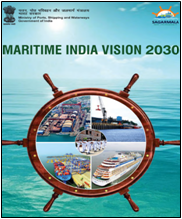
In a bold move to position itself as a global maritime powerhouse, India has set sail with the Maritime India Vision 2030 (MIV 2030), a transformative roadmap launched in 2021. With over 150 strategic initiatives, the vision seeks to modernise ports, expand shipping capacity, and strengthen inland waterways, while embedding sustainability and skill development at its core. More than a blueprint for cargo movement, MIV 2030 is a catalyst for trade, investment, and employment, charting India’s course toward economic growth and global competitiveness.
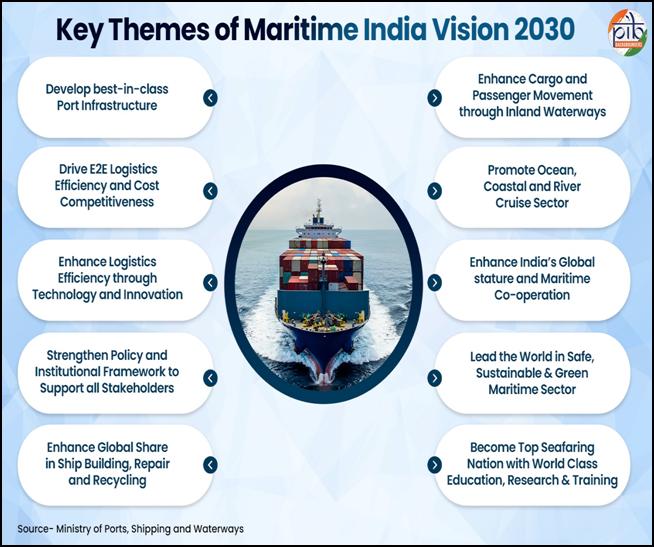
Central Themes of MIV 2030
The Maritime India Vision 2030 identifies ten pivotal themes that will shape India’s journey toward becoming a global maritime powerhouse, positioning the nation at the forefront of the international landscape.
India Maritime Week 2025: A Global Platform
India Maritime Week 2025 (IMW 2025) is a landmark event in the global maritime calendar, taking place from 27th to 31st October 2025 at the NESCO Exhibition Centre, Mumbai. Bringing together key stakeholders from the shipping, port, and logistics communities, IMW 2025 will serve as a strategic platform for dialogue, collaboration, and business development. The event is expecting participation from over 100 countries and drawing more than 100,000 delegates, port operators, investors, innovators, and policymakers alike. The five-day programme will feature 500 exhibitors, thematic pavilions, technology demonstrations, and sessions spanning port-led development, shipbuilding clusters, and digital corridors.
A Decade of Maritime Transformation: 2014 to 2025
Charting a new course for economic growth, India’s maritime sector is cruising ahead with record performance across ports, coastal shipping, and inland waterways. The sector’s progress underscores its critical role in strengthening the nation.
India’s Ports Set New Benchmarks
India’s ports sector has witnessed a transformative leap, with total port capacity nearly doubling from 1,400 million metric tonnes per annum (MMTPA) to 2,762 MMTPA, reflecting major investments in modernisation and infrastructure. Cargo handling volumes have grown impressively from 972 Million Metric Tonnes (MMT) to 1,594 MMT, signaling robust growth in maritime trade and port efficiency with major ports handling approximately 855 million tonnes of cargo in FY 2024-2025, an increase from 819 million tonnes in FY 2023-24. Operational performance has improved significantly, as the average vessel turnaround time has been reduced from 93 hours to just 48 hours, enhancing overall productivity and global competitiveness.
The sector’s financial strength has surged, with the net annual surplus rising sharply from ₹1,026 crore to ₹9,352 crore, underscoring improved revenue generation and cost management. Efficiency indicators have also strengthened, with the operating ratio improving from 73% to 43%, marking a major step toward sustainable and profitable port operations.
Indian Shipping Expands Fleet, Capacity, and Workforce
India’s shipping sector has charted steady growth, with the number of Indian-flagged vessels rising from 1,205 to 1,549, reflecting the nation’s expanding maritime presence. The gross tonnage of the Indian fleet has increased from 10 million gross tonnes (MGT) to 13.52 MGT, underscoring a stronger and more capable shipping capacity. Coastal shipping has gained significant momentum, with cargo movement nearly doubling from 87 million metric tonnes (MMT) to 165 MMT, reinforcing the shift toward efficient, low-cost, and eco-friendly transport modes.
Inland Waterways Surge Ahead
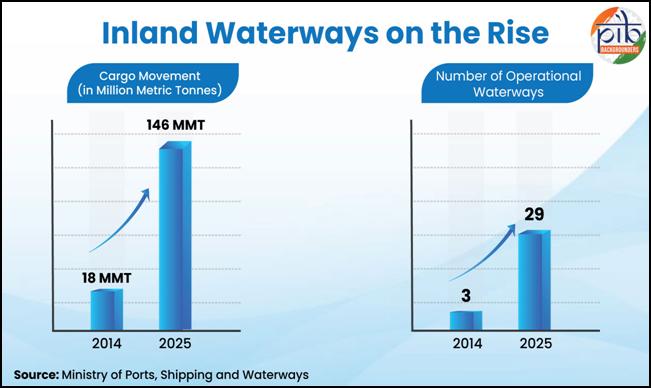
In a landmark development for the inland water transport sector, the Inland Waterways Authority of India (IWAI) reported a record cargo movement of 146 MMT in 2025, up from 18 MMT in 2014, an increase of around 710 percent. The number of operational waterways has increased remarkably from 3 to 29, reflecting a major boost to India’s inland transport network. IWAI handed over the Haldia Multi-Modal Terminal (MMT) to IRC Natural Resources, marking a major step in advancing inland waterway infrastructure and promoting multimodal logistics under the Public Private Partnership (PPP) model.
Financing the Waves: Investments and Innovation
The MIV 2030 projects a total investment of INR 3–3.5 lakh crore across ports, shipping, and inland waterways. Backed by a recent landmark package of ₹69,725 crore to boost shipbuilding and revitalise the maritime ecosystem, India is charting a strategic course to leverage its vast coastline to anchor itself firmly on the global maritime map.
With a ₹25,000 crore corpus, the Maritime Development Fund (MDF) is set to provide long-term financing to expand India’s shipping tonnage and shipbuilding capacity. Complementing this, the revamped Shipbuilding Financial Assistance Scheme (SBFAS) with an outlay of ₹24,736 crore, tackles domestic cost disadvantages and incentivises ship-breaking, while the Shipbuilding Development Scheme (SbDS) drives greenfield clusters, yard expansions, and risk coverage with ₹19,989 crores outlay.
Sailing into the Future: Maritime Amrit Kaal Vision 2047
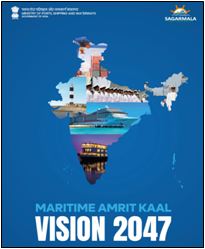
India’s maritime sector is entering a decisive decade, with new laws, mega projects, and global investment ambitions shaping the Maritime India Vision 2030. With a strong focus on green technologies and digital innovation, India is preparing to not only meet its trade demands but also emerge as a maritime leader. Building onto this foundation is the Maritime Amrit Kaal Vision 2047, a long-term roadmap for India’s maritime resurgence, with investments of nearly ₹80 lakh crore earmarked for ports, coastal shipping, inland waterways, shipbuilding, and green shipping initiatives.
Sources
This article is based on information provided by the Press Information Bureau (PIB) Delhi, published on 26 October 2025. Additional details were sourced from the Ministry of Ports, Shipping and Waterways and related official reports. Below is a list of referenced sources:
- MoPSW Achievements and Initiatives FY 2023-24
- Year End Review 2024
- Maritime India Vision 2030
- MIV 2030 Report
- India Maritime Week
- PIB Press Release 2080012
- PIB Press Release 2128329
- PIB Press Release 2167305
- PIB Press Release 2179164
- PIB Press Release 2175547
- PIB Press Release 2170575
- PIB Press Release 2160804
- PIB Press Release 2166156
- PIB Press Release 2124061
- PIB Factsheet 149248
- PIB Press Release 2180221
- PIB Press Release 2171836
- PIB Press Release 2163161
- PIB Press Release 2115878
- PIB Press Release 2179597
- PIB Press Release 1992273
- PIB Press Release 2172488
- PIB Factsheet 149248
- PIB Press Note 154624
- PIB Press Note 155540
- PMO Press Release 2168875