Union Environment Minister Chairs High-Level Review Meeting on Greening Strategy for Delhi NCR
District-wise Planning Key to Ecological Security and Air Quality Improvement: Shri Bhupender Yadav
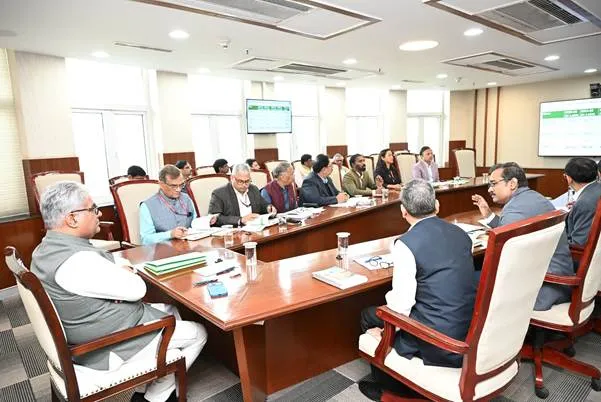
Union Minister for Environment, Forest and Climate Change, Shri Bhupender Yadav, chaired a high-level review meeting in New Delhi to assess preparations for plantation initiatives aimed at greening the Delhi-NCR region. The meeting included the Secretary (EFCC), senior officers of the Ministry, and Principal Chief Conservators of Forests (PCCFs) from Haryana, the Government of NCT of Delhi, Rajasthan, and Uttar Pradesh.
The discussions focused on implementing a scientifically-planned, community-engaging, and convergence-based approach to enhance green cover across the NCR through a comprehensive district-wise action plan. This plan will cover both rural and urban areas, utilizing forest and other government lands, as well as identifying urban land parcels under the jurisdiction of Urban Local Bodies.
Comprehensive Mapping of Green and Public Spaces
Shri Yadav reviewed the progress of plantation site identification for 2026-27 and requested NCR States to conduct detailed district-wise planning, including:
- Identification of total forest areas, Protected Areas, Zoos (existing and proposed), Community forests, revenue forests, and Nagar Vans/Namo Parks (proposed and approved)
- Mapping of degraded forest land
- Catchment areas of rivers, water bodies, wetlands, and Ramsar sites
- Other public spaces under different authorities, including Revenue lands, Panchayati Raj Institutions (PRIs), and Urban Local Bodies (ULBs)
- Classification of areas based on existing vegetation and managing agencies
- Identification of nurseries in rural and urban areas
- Convergence of resources available with different agencies
The Minister also emphasized mapping and engagement of all Eco-Clubs in NCR for awareness and participation in plantation and maintenance activities. He requested the involvement of Natural History and its regional centers. States were instructed to map existing nurseries, assess production capacities, and evaluate requirements for strengthening them to meet future plantation needs. Based on this information, States will conduct spatial analyses to determine suitable plantation areas, types of interventions, stakeholders involved, and prepare detailed district-wise action plans.
Preparation of District-Level Micro Plans for Next Five Years
Shri Yadav called on the States to assess existing forest and wildlife management plans, considering Hon’ble Court directions applicable to the NCR, and prepare five-year Micro Plans. The plans should identify:
- Areas for annual plantation activities
- Implementing agencies
- Opportunities for community participation
- Nature of plantation interventions
- Nurseries and sources of quality planting material
- Funding sources under existing schemes such as Green India Mission, Nagar Van Yojana, Green Credit Programme (GCP), Compensatory Afforestation Fund, State funds, MGNREGA, river rejuvenation programmes, and other relevant schemes
The Minister highlighted the need to identify areas affected by invasive species and include eco-restoration measures in the Micro Plans. He stressed that the plans should indicate departments and ministries requiring convergence for effective implementation and suggested reviewing ongoing litigations to address regulatory constraints.
Preparation of a Five-Year Greening Plan for NCR
Shri Yadav requested the Ministry officials to prepare a Five-Year Greening Plan for the National Capital Region by consolidating district-wise Micro Plans from the States. This integrated plan will guide coordinated actions, supporting plantation efforts monitored by the Commission for Air Quality Management (CAQM).
FSI Support and Green Credit Programme
The Minister instructed the Forest Survey of India (FSI) to provide data on degraded forest lands and areas affected by invasive species to aid State planning. States were directed to list degraded forest lands on the Green Credit Programme (GCP) portal to facilitate participation by individuals, public, and private entities in eco-restoration, in line with approved Micro Plans.
Shri Yadav emphasized that a scientifically-planned, technology-enabled, and convergence-based district-wise greening strategy is essential for ecological security and sustained air quality improvement in NCR. He stated that a follow-up meeting would be held soon to review the progress of actions taken by the State Governments and the Government of NCT of Delhi.