RAK College of Nursing Holds Graduation Ceremony Honouring Future Healthcare Professionals
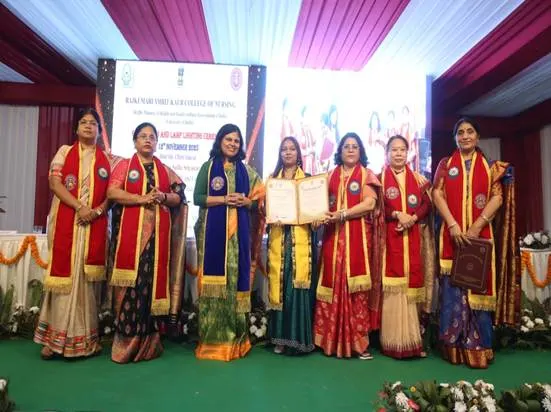
The Rajkumari Amrit Kaur College of Nursing, New Delhi, celebrated its Graduation and Lamp Lighting Ceremony on 12 November 2025 for the M.Sc. Nursing batch of 2022–2024 and the B.Sc. Nursing batch of 2020–2024. Union Health Secretary Smt. Punya Salila Srivastava graced the occasion as the Chief Guest and delivered the keynote address. The event was also attended by Dr. Achala, Additional Director General (Nursing), Directorate General of Health Services, and Professor (Dr.) K. Ratnabali, Dean of Academic Affairs, University of Delhi.
Addressing the graduates, Smt. Srivastava commended nurses as the backbone of India’s healthcare delivery system and vital contributors to achieving Universal Health Coverage. She encouraged students to embody empathy, dedication, and ethical values in their professional practice, emphasizing their critical role in ensuring quality healthcare across all communities.
Dr. Achala highlighted the importance of the Oath Ceremony, reminding graduates of their lifelong commitment to compassionate service. The Nightingale Pledge was administered by Mrs. Sarita Shokandha, Academic In-Charge, symbolizing the graduates’ formal entry into the profession. Degrees were conferred, and meritorious students received awards for their exceptional achievements. The event concluded with a collective celebration of the nursing profession’s pivotal role in national health development.
India Achieves Record Decline in Tuberculosis Incidence under TB Mukt Bharat Abhiyan
India has achieved a 21% reduction in tuberculosis (TB) incidence, dropping from 237 cases per lakh population in 2015 to 187 per lakh in 2024, nearly twice the global rate of decline. According to the World Health Organization’s Global TB Report 2025, this progress marks one of the steepest declines in TB incidence worldwide and highlights the country’s strong commitment toward eliminating TB.
The nation’s treatment coverage has expanded significantly to 92%, surpassing other high-burden countries. In 2024, over 26.18 lakh TB patients were diagnosed, reflecting the success of innovative case-finding strategies and expanded access to diagnostic and treatment facilities. The treatment success rate under the TB Mukt Bharat Abhiyan has risen to 90%, exceeding the global average of 88%.
Early detection has been strengthened through extensive use of molecular testing and AI-based technologies. India’s susceptibility testing coverage for Rifampicin now stands at 92%, compared to the global average of 83%. The country operates the world’s largest TB laboratory network, comprising 9,391 rapid molecular testing facilities and 107 culture and drug susceptibility testing laboratories. Over 500 AI-enabled handheld X-ray devices are already deployed, with 1,500 more being distributed to states and union territories.
The TB Mukt Bharat Abhiyan, launched in December 2024, has screened more than 19 crore individuals from vulnerable groups and identified 24.5 lakh TB patients, including 8.61 lakh asymptomatic cases. The annual budget for the programme has increased ten-fold over the past nine years, allowing the introduction of modern diagnostic tools, new preventive interventions, and strengthened social support mechanisms.
Under the Ni-kshay Poshan Yojana, financial assistance of ₹1,000 per month is provided to TB patients throughout their treatment. Since April 2018, ₹4,406 crore has been disbursed to 1.37 crore beneficiaries. Community engagement has also expanded with over 6.77 lakh Ni-kshay Mitras contributing more than 45 lakh food baskets to TB patients, and two lakh My Bharat volunteers providing psychosocial support across the country.
The Ministry of Health and Family Welfare continues to implement a differentiated TB care approach that provides tailored treatment to high-risk patients. ASHA workers have been trained to identify early warning signs and ensure timely referrals. The mission aims to achieve comprehensive early detection, treatment, nutritional, and psychosocial support to eliminate TB transmission and mortality, moving closer to a TB-Mukt Bharat.
National Consultation Advances Nursing Education and Workforce Reforms
The Union Ministry of Health and Family Welfare, in partnership with the World Health Organization (WHO) and Jhpiego, organized a three-day National Consultation and Experience-Sharing Workshop on Nursing Policy Priorities and Best Practices in India. The event brought together policymakers, educators, regulators, and health sector partners to discuss reforms in nursing education, workforce management, and policy development.
Union Health Secretary Smt. Punya Salila Srivastava highlighted that nurses and midwives remain central to India’s healthcare system and are instrumental in achieving Universal Health Coverage alongside Ayushman Arogya Mandirs and ASHA workers. She emphasized the establishment of the National Nursing and Midwifery Commission and the adoption of competency-based curricula as major steps toward modernizing the sector.
Professor V.K. Paul, Member (Health), Niti Aayog, praised India’s nursing workforce for its contribution to delivering quality healthcare and called for continued reforms in education and in-service training. He stressed the importance of skill enhancement and leadership development to maintain professional excellence.
Dr. Payden, WHO Representative to India, noted that India has emerged as one of the largest contributors to the global nursing workforce. She acknowledged that the projected reduction in the shortage of nurses in the WHO South-East Asia Region by 2030 is largely due to India’s progressive policy measures and educational reforms.
The workshop covered key policy areas such as equitable workforce distribution, quality assurance in training institutions, and improved career pathways. Technical sessions, panel discussions, and state-level presentations showcased innovations in digital learning and nursing leadership. These deliberations aim to strengthen evidence-based policymaking and ensure a resilient and empowered nursing workforce across India.