National One Health Mission Assembly Concludes With Focus on Collaboration and Preparedness
Deliberations Emphasize Medical Countermeasures, Capacity Building and Community Engagement
The two-day National One Health Mission Assembly 2025 concluded at Bharat Mandapam with extensive discussions aimed at reinforcing an integrated and resilient One Health ecosystem. The event brought together senior representatives from key ministries, scientific institutions, development partners and implementation agencies, highlighting the significance of coordinated action across human, animal and environmental health sectors.
Day 2 Discussions Strengthen Integrated Action
Building on the commitments reiterated on the first day by senior government leadership, the second day featured scientific, operational and programmatic deliberations. These sessions advanced common priorities related to preparedness, rapid response mechanisms and long-term One Health integration.
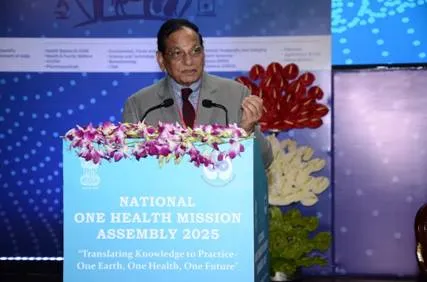
The proceedings were guided by national and international experts. Dr V K Paul, Member (Health), NITI Aayog, opened the discussions by underscoring the importance of continuous collaboration, system readiness and enhanced national capacities. He was joined by Dr Rajiv Bahl, Secretary, Department of Health Research and Director General, ICMR, and Dr Rajesh S Gokhale, Secretary, Department of Biotechnology, who spoke about the role of innovation, translational research and integrated surveillance. Inputs from Mr. Scott Newman of the Food and Agriculture Organization and Smt. Vandana Jain, Joint Secretary, Ministry of Health and Family Welfare, reinforced the relevance of multisectoral cooperation and global partnerships. Experts from DRDO, ICAR, THSTI, CEPI, FIND, AYUSH and the International Vaccine Institute contributed scientific and implementation perspectives.
Focus on Community Engagement and System Preparedness
Addressing the Assembly, Dr Vinod Kumar Paul stated that India’s progress in One Health depends on a whole-of-government approach that supports a healthier and more resilient future. He emphasized that community engagement is central to disease detection, surveillance and rapid response, noting that community-driven mobilization was a key strength during the COVID-19 pandemic. He highlighted that frontline workers, local governments and communities form the foundational level of preparedness and noted that the Assembly marked an important point in bringing together multiple stakeholders for integrated action.
Scientific Innovation and the Future of One Health
Dr Rajiv Bahl stated that science, technology and development must work together to develop diagnostics, therapeutics and vaccines with greater speed. He emphasized that the National One Health Mission platform is contributing to a more agile and responsive system for managing public health threats. Dr Rajesh S Gokhale noted that COVID-19 demonstrated both vulnerability and global interdependence in technology. He stated that the convergence of biological, artificial and natural intelligence will shape future technological developments and will be key to strengthening India’s One Health and bioscience capabilities.
Deliberations on Medical Countermeasures and Operational Readiness
Experts from national and international research bodies discussed the need to accelerate the development of vaccines, diagnostics and therapeutics for emerging threats. They emphasized flexible research platforms, strengthened regulatory pathways for emergency use and increased collaboration among scientific institutions, industry and global partners. State governments provided operational insights based on field-level experience with surveillance, inter-departmental coordination and readiness.
Capacity Building and Community Engagement Insights
Discussions on capacity building highlighted that a strong One Health ecosystem depends on skilled personnel, credible institutions and active community involvement. Experts from wildlife health, public health training, community research and health systems development discussed the need for multi-level training structures, incorporation of One Health concepts into professional education and lasting community partnerships. State government representatives shared examples of locally adapted strategies and community-focused interventions.
Exhibition and Hackathon Recognize Innovation
An exhibition showcased India’s expanding One Health capabilities, including innovations in surveillance, biosafety, digital systems, laboratory networks and collaborative research. A felicitation ceremony recognized participants of the National One Health Hackathon, which invited technology-oriented and community-focused proposals. The initiative brought together student and early-career teams who developed prototypes addressing practical One Health challenges.
Shared Commitment to Advancing Viksit Bharat
The Assembly concluded with a common understanding that One Health is essential to advancing the vision of Viksit Bharat. Through scientific progress, cross-sectoral cooperation and strengthened preparedness across all levels, India continues working toward a safer and more resilient future.