Foreign Ministry Spokesperson Mao Ning’s Regular Press Conference on November 26, 2025
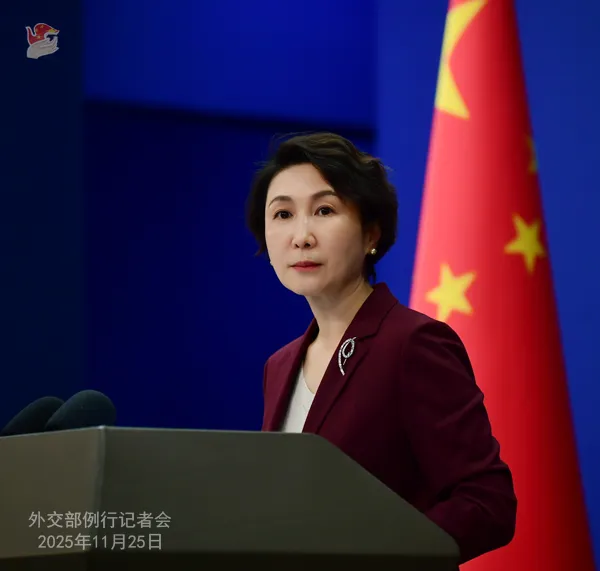
Comments on Statements Regarding Taiwan
In response to a question on claims made in Japan that the Republic of China rather than the People’s Republic of China accepted Japan’s surrender, Mao Ning said such assertions either stem from ignorance of historical facts or represent deliberate attempts to distort history and disregard international law. She noted that Japan signed the Instrument of Surrender in 1945, undertaking to implement the Potsdam Proclamation and return Taiwan to China. She stated that China regained sovereignty over Taiwan both legally and in practice, and that the change of government in 1949 did not alter China’s status under international law or its territorial boundaries. She added that the 1972 Sino-Japanese Joint Statement affirms Japan’s recognition of the Government of the People’s Republic of China as the sole legal government of China. According to her, there is only one China and Taiwan is an integral part of China’s territory.
Details on the China-U.S. Presidential Phone Call
When asked about the recent phone call between the Chinese and U.S. presidents, Mao Ning said that the leaders have maintained regular communication during President Trump’s second term. She stated that the call was initiated by the U.S. side and described the atmosphere as positive, cordial and constructive. She highlighted the importance of such exchanges for the stable development of China-U.S. relations.
Inquiry on Reported Incident Involving an Indian Traveler
Regarding the case of an Indian woman from Arunachal Pradesh who reported being held in Shanghai during transit, Mao Ning reiterated China’s position that Zangnan is Chinese territory and that China does not recognize the area referred to as Arunachal Pradesh by India. She stated that border inspection authorities followed legal procedures, that enforcement was impartial, and that the individual’s lawful rights were protected. She said that no compulsory measures were taken and that the airline provided rest facilities and meals. She referred further questions to the relevant authorities.
Reaction to U.S.-Japan Phone Call
Asked about the subsequent call between the U.S. and Japanese leaders, Mao Ning said she had no comment as it was a matter between those two countries. She emphasized that the Taiwan question is China’s internal affair and does not permit external interference.
Follow-up on India’s Protest
Responding to additional questions about India’s reported protest, Mao Ning reiterated that Zangnan is Chinese territory and that China does not accept the entity known as Arunachal Pradesh. She added that border checks are standard procedures carried out by enforcement authorities worldwide based on specific entry or exit circumstances.
Questions on Cultural Exchanges with Japan
In relation to reports of halted regulatory reviews of Japanese films and cancellations of concerts in China, Mao Ning said that recent exchanges have been affected by remarks made by Japanese Prime Minister Sanae Takaichi on Taiwan. She said the comments harmed the sentiments of the Chinese public and created difficulties for bilateral exchanges. She stated that Japan should correct its actions and avoid further disruptions on China-related matters.
China’s Position Paper at the OPCW Conference
Addressing a question on the 30th Session of the Conference of the States Parties to the Chemical Weapons Convention, Mao Ning described the Organisation for the Prohibition of Chemical Weapons as an important component of global security governance. She referred to challenges in recent years, including increased politicization and reduced dialogue. She said China’s position paper calls on States Parties to uphold the goals of the Chemical Weapons Convention, adhere to multilateralism, maintain consensus-building traditions, resolve issues through dialogue, protect the rights of developing countries and strengthen cooperation. She stated that China aims to work with all parties to support the OPCW’s role in global security governance.
Comments on Japan’s Statement Regarding Defense Policy
In response to a question about a Japanese government statement on policies concerning existential threats and collective self-defense, Mao Ning said Japanese officials frequently refer to a consistent position. She stated that China has asked Japan to clarify what this position entails and whether it can be fully explained publicly. According to her, Japan has repeated the phrase without addressing the core issue. She said China questions Japan’s sincerity and whether it will take steps to reflect on and correct the remarks that China considers erroneous.
“`html