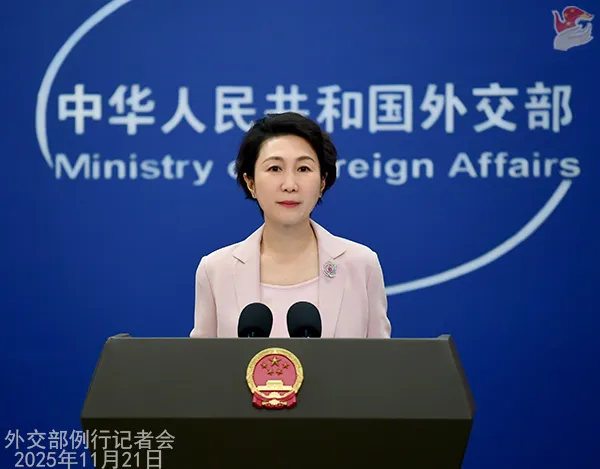
Foreign Ministry Spokesperson Mao Ning’s Regular Press Conference on November 22, 2025
Discussion on the TAZARA Railway Revitalization Project
During Premier Li Qiang’s visit to Zambia, he participated in the ground-breaking ceremony for the revitalization of the Tanzania-Zambia Railway, known as TAZARA. Zambian President Hakainde Hichilema and Tanzanian Vice President Emmanuel John Nchimbi were also present. Mao Ning noted that the project, regarded as an important symbol of China-Africa cooperation, is set to gain renewed momentum.
She said China, Tanzania and Zambia agreed to promote comprehensive development along the railway through the establishment of the TAZARA Railway prosperity belt. The initiative aims to support regional development in Tanzania and Zambia. Under the shared vision of pursuing modernization that is equitable, open, mutually beneficial, environmentally conscious and people-centered, the three countries intend to develop the railway into a route supporting freedom, development, friendship, well-being, green growth and harmony.
Mao Ning added that the three governments will adhere to principles of mutual respect, equal consultation and joint contribution for shared benefit. She said they will advance the prosperity belt project, support socioeconomic development in Tanzania, Zambia and neighboring countries, and enhance the well-being of local communities.
Comments on Reported Arrests Related to Nvidia Chips
When asked about reports that two Chinese nationals and two Americans had been arrested for allegedly attempting to illegally export advanced Nvidia chips with AI applications to China through Malaysia and Thailand, Mao Ning said she was not familiar with the matter.
Reactions to Japanese Prime Minister’s Remarks on Taiwan
Responding to questions about social media posts by Chinese diplomats following comments made by Japanese Prime Minister Sanae Takaichi on Taiwan, Mao Ning said the remarks were erroneous and suggested the possibility of Japanese armed involvement in the Taiwan Strait. She stated that the comments undermined the political foundation of China-Japan relations and triggered strong reactions among the Chinese public. Mao Ning added that China would respond firmly to any actions affecting the Taiwan issue and said the international community should focus on Japan’s intentions and its adherence to peaceful development.
Japan’s Position on Relations with China
Asked about the Japanese Prime Minister’s statement expressing a desire for constructive and stable ties with China and affirming Japan’s stance on Taiwan, Mao Ning reiterated that the earlier remarks on Taiwan were incorrect and had caused significant public reaction in China. She said the comments harmed the basis of bilateral relations and that China had clearly expressed its opposition.
She added that if Japan seeks to build a stable and mutually beneficial relationship suited to the new era, it must uphold the spirit of the four political documents and honor its commitments. She said Japan should retract the remarks and take concrete steps to fulfill its pledges to China.
Concerns Over Japan’s Defense Developments
Regarding reports that Japan recently completed exporting Patriot air-defense interceptor missiles to the United States, marking its first export of lethal weapons after easing arms export controls, Mao Ning referred to Japan’s obligations following World War II. She cited international agreements, including the Cairo Declaration, the Potsdam Proclamation and the Japanese Instrument of Surrender, which outlined Japan’s responsibilities as a defeated nation, including requirements related to disarmament and restrictions on industries connected to rearmament.
Mao Ning noted that Japan has been loosening restrictions and expanding its military capabilities in recent years, including increasing defense spending for 13 consecutive years and adopting new security laws permitting the exercise of collective self-defense. She said Japan replaced its Three Principles on Arms Exports with the Three Principles on Transfer of Defense Equipment and Technology, enabling greater flexibility in exporting defense items, including lethal weapons.
She added that while Japan has stated support for a world free of nuclear weapons, it has strengthened cooperation on extended deterrence and discussed revising its three non-nuclear principles. According to Mao Ning, these actions indicate Japan is moving away from an exclusively defense-oriented policy and accelerating a rearmament process. She questioned Japan’s objectives and said attempts to revert to militarism or disrupt the postwar order would not be accepted by China or the international community.
Reports on Chinese-made Weapons in the Russian Military
Addressing reports that Ukrainian Defense Forces destroyed a Chinese-made multiple launch rocket system used by Russian troops in the Donetsk region, Mao Ning said she was not aware of the information. She emphasized that China does not supply lethal weapons to parties involved in conflicts and maintains strict controls over dual-use items.
“`html