UAE and Finland Issue Joint Statement During Official Visit
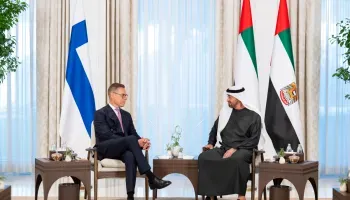
ABU DHABI 22nd November, 2025 President His Highness Sheikh Mohamed bin Zayed Al Nahyan received His Excellency Alexander Stubb, President of the Republic of Finland, in Abu Dhabi during an official visit that highlighted the strength of bilateral relations and the shared commitment to expanding cooperation in political, economic, technological, and multilateral fields.
The leaders noted that the visit took place following the 50th anniversary in February 2025 of the establishment of diplomatic relations, which provides a foundation for shaping an ambitious agenda for future cooperation. They agreed to enhance collaboration in renewable energy, the green transition, artificial intelligence, digital transformation, advanced technology, education, space, and sustainable development.
Both Presidents welcomed the continued growth of trade and investment ties and underlined the importance of joint work between public institutions and private sector entities. They identified advanced and emerging technology, space, sustainable finance, clean energy, and the circular economy as key areas for upcoming cooperation.
The leaders commended the efforts of Emirati and Finnish institutions, including ATRC, EDGE, Nokia, Space42, Bluefors, ICEYE, and Business Finland, in promoting innovation ecosystems, collaborative research, and industrial partnerships.
The two sides welcomed ongoing cooperation in education, such as university partnerships, digital learning platforms, STEM programmes, and teacher training. They expressed willingness to consider joint initiatives in Africa and other regions in sectors including digital education, renewable energy, and climate resilience, drawing on the strengths of Emirati development organisations and Finnish technology partners.
Both leaders underlined the potential for expanding collaboration in the space sector. They referenced Finland’s capabilities in microsatellites and earth-observation technology and the UAE’s growing space exploration capacity. They also noted the role of companies such as ICEYE, which is establishing a regional base in Abu Dhabi, in supporting cooperation in climate monitoring, environmental management, and disaster response.
The leaders reaffirmed that water is central to climate action and pledged to address global water challenges by strengthening international cooperation. They highlighted the 2026 UN Water Conference, co-hosted by the UAE and Senegal, as an important platform for advancing water-related efforts and pointed to the UAE’s 2024 Mohamed bin Zayed Water Initiative as an example of investment in water technology and innovation.
Both leaders restated their commitment to supporting the Women, Peace and Security agenda and noted the need to advance women’s full and meaningful participation in peacebuilding, peace processes, and conflict prevention at the global, regional, and national levels. They recognised the progress made through joint efforts in this field.
The leaders emphasised the importance of adopting and implementing UNSCR 1325 Regional and National Action Plans on Women, Peace and Security to translate commitments into concrete action.
The leaders exchanged views on regional and international developments. They affirmed their joint commitment to achieving a comprehensive, just, and lasting peace based on the two-state solution, leading to the creation of a sovereign, independent, and viable Palestinian State living alongside Israel in peace and security, based on the 4th June 1967 lines and in line with international law and relevant United Nations resolutions.
Both sides welcomed the leadership of US President Donald J. Trump and his Comprehensive Peace Plan to end the war in Gaza. They also welcomed the UN Security Council’s adoption of resolution 2803, described as an important mechanism for implementing the plan and outlining a path toward Palestinian self-determination and statehood.
The leaders expressed appreciation for the efforts by the US and regional partners to achieve a ceasefire in the Gaza Strip. They stressed the importance of all parties adhering to the ceasefire to ease humanitarian suffering and create conditions favourable to lasting peace.
The two leaders raised concerns about the spread of extremism and ideologies that contribute to terrorism and conflict. They reiterated their commitment to countering hate speech, extremism, and racism through tolerance and interreligious and intercultural dialogue, in line with UN Security Council Resolution 2686. They reaffirmed their countries’ opposition to extremism in all its forms.
The leaders reiterated the EU-GCC Summit Joint Statement from October 2024 and the EU-GCC Ministerial Joint Statement from October 2025, calling on Iran to end its occupation of the UAE’s islands of Greater Tunb, Lesser Tunb, and Abu Musa, which they described as a violation of the UAE’s sovereignty and the principles of the UN Charter.
The leaders expressed deep concern about the lack of progress in resolving the dispute over the three islands. They reaffirmed support for a peaceful resolution through bilateral negotiations or referral to the International Court of Justice in accordance with international law and the UN Charter.
The two leaders condemned attacks against civilians by the Rapid Support Forces in El Fasher and by both warring parties throughout Sudan. They stressed that the Sudanese Armed Forces and the Rapid Support Forces carry the primary responsibility to protect civilians and humanitarian workers.
The two sides highlighted that ending the conflict rests with both the SAF and the RSF. They stressed the need for accountability for violations of international humanitarian law and reaffirmed their support for Sudan’s sovereignty, unity, and territorial integrity.
They welcomed the ongoing efforts of the Quad, comprising the United States, United Arab Emirates, Kingdom of Saudi Arabia, and Egypt. They underscored the need for an immediate ceasefire, unhindered humanitarian access across Sudan, and a transparent transition that leads to an independent, civilian-led government with broad legitimacy and accountability.
Both leaders stated that a sustainable path to peace in Sudan cannot be achieved through military action. They also noted that Sudan’s future should not be shaped by violent extremist groups associated with or linked to the Muslim Brotherhood or other organisations whose influence has contributed to instability.
The leaders reaffirmed their commitment to supporting a comprehensive, just, and lasting peace in Ukraine, in accordance with international law and the principles of the UN Charter, including respect for sovereignty, independence, and territorial integrity. They recognised the importance of diplomatic efforts and peace-oriented initiatives and agreed to continue coordination in multilateral forums.
The leaders strongly condemned intensifying attacks in Ukraine that have resulted in rising civilian casualties and damage to essential infrastructure. They also noted the need to address global challenges related to food security, energy supplies, and the safety of nuclear facilities.
The Finnish President acknowledged the UAE’s role in facilitating humanitarian assistance and prisoner exchanges between Ukraine and the Russian Federation.
The visit concluded with both leaders affirming their commitment to strengthening the UAE-Finland partnership based on mutual respect, shared strategic priorities, and the common goal of promoting peace, stability, and sustainable prosperity. They welcomed the outcomes of the Official Visit and agreed to follow up through existing bilateral mechanisms to ensure timely implementation of all agreed initiatives.