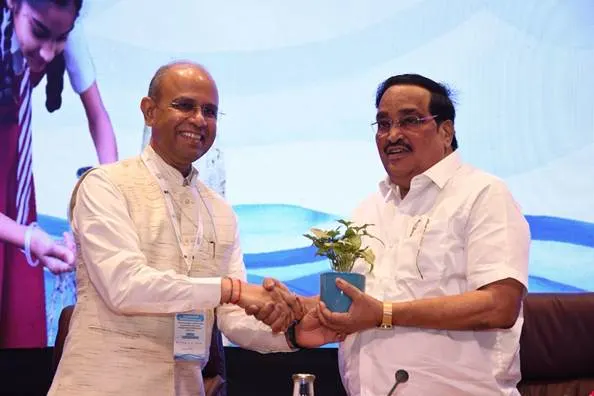
The Department of Drinking Water and Sanitation (DDWS), Ministry of Jal Shakti, organised a one-day workshop of the Rural WASH Partners’ Forum (RWPF) on “Communication and PRA Tools to Promote Community Engagement (Jan Bhagidari)” on 12 November 2025 at SCOPE Complex, New Delhi. The event saw the active participation of Union Minister of Jal Shakti Shri C.R. Patil, senior DDWS officials, representatives from various ministries, and development partners.
Union Minister Launches Key Jal Jeevan Mission Initiatives
Union Minister Shri C.R. Patil inaugurated several new initiatives to strengthen participatory rural water governance. These included the Decision Support System (DSS) for Source Sustainability, the JJM Panchayat Dashboard, the first episode of the Community Radio Programme “Swachh Sujal Gaon Ki Kahani: Radio Ki Zubani”, and the Handbook on Community-Managed Piped Water Systems – “Jan Bhagidari se Har Ghar Jal”.
Highlighting the Prime Minister’s vision of “Jan Bhagidari se hi Jan Kalyan sambhav hai”, Shri Patil said that over nine crore women have been freed from the burden of fetching water. As per WHO estimates, rural India saves nearly 5.5 crore person-hours daily, improving productivity and women’s participation in the workforce. He further noted that the “Jal Sanchay Jan Bhagidari” initiative focuses on groundwater recharge, rainwater harvesting, and borewell rejuvenation to ensure long-term water sustainability.
Empowering Panchayats and Communities through Data and Participation
In his address, DDWS Secretary Shri Ashok K.K. Meena stated that Jan Bhagidari forms the foundation of the Jal Jeevan Mission, which is designed as a bottom-up programme based on community ownership and sustainability. He underlined the role of communication and behavioural change tools in turning community engagement into actionable outcomes.
Decision Support System (DSS) for Source Sustainability
The DSS is a comprehensive digital planning platform that integrates multi-source datasets to guide data-driven decision-making for water source sustainability. It is currently operational in 234 districts, with the remainder to be onboarded within the current financial year. The system integrates layers from key national data agencies, including:
| Data Layer | Source |
|---|---|
| Rainfall (Decadal Mean) | Central Ground Water Board (CGWB) |
| Water Level (Decadal Mean) | CGWB |
| Slope and Elevation | BISAG-N |
| Drainage and Aquifers | National Water Informatics Centre (NWIC) |
| Recharge Potential Areas | CGWB |
| Land Use and Land Cover | NRSC–NWIC |
| Water Quality | CGWB |
Future enhancements will include Springshed data, criticality assessments, and artificial recharge structures, complemented by district-level rainfall data from IMD and Agriculture Departments. The system will align with revised MGNREGA guidelines mandating expenditure on water-related works, thereby ensuring source sustainability through convergence planning.
Interactive Panchayat Dashboard
The new JJM Panchayat Dashboard enables real-time data access and transparency for local bodies through the e-Gram Swaraj Portal. To date, 67,273 Sarpanch and Panchayat Secretaries have logged in. The dashboard allows Panchayats to:
- Update water supply status and functionality data.
- Access water quality information and IEC material.
- View pipelines and assets under PM Gati Shakti.
- Update details of Water Supply Operators.
- Report issues for prompt action by higher authorities.
Connecting Rural India through Community Radio
The programme “Swachh Sujal Gaon Ki Kahani: Radio Ki Zubani” was launched to connect rural communities through storytelling and local dialogue. It will air across 100 community radio stations in 13 national and 34 local dialects in collaboration with the Community Radio Association (CRA). Characters Sujal Kumar and Swachhika Kumari narrate stories of rural transformation in the WASH sector, accompanied by quizzes and participatory community segments to enhance awareness and engagement.
Handbook on Community-Managed Piped Water Systems
The newly released handbook “Jan Bhagidari se Har Ghar Jal” serves as a guide for Gram Panchayats, Village Water and Sanitation Committees (VWSCs), and community institutions on commissioning, management, and handover of rural water supply systems. It also introduces District Technical Units (DTUs) to bridge policy and field-level implementation, ensuring sustainability and accountability.
The handbook encourages symbolic village-level celebrations such as “Jal Arpan”, “Jal Bandhan”, and “Jal Utsav”, promoting collective ownership and pride in maintaining local water systems.
Collaborative Deliberations and Field Tools
During the workshop, RWPF partners and State IEC teams co-created Participatory Rural Appraisal (PRA) tools covering areas such as:
- Functionality and service delivery assessment
- Source sustainability and protection
- Commissioning and handover protocols
- Preventive maintenance and grievance redressal
- VWSC enterprise models
- Greywater management
- Community celebration models like Lok Jal Utsav
Summarising the deliberations, Joint Secretary (NJJM) Smt. Swati Meena Naik noted that these PRA tools mark a step towards decentralised programme implementation. The initiatives encourage community participation and strengthen local governance for sustainable water supply management.
Commitment to Sustainable Water through Jan Bhagidari
Concluding the workshop, Additional Secretary and Mission Director (NJJM) Shri Kamal Kishore Soan urged participants to translate these tools and innovations into field-level outcomes. “Jal Jeevan Mission is a people’s movement built on trust, participation, and purpose,” he said, reaffirming the goal of “Jan Bhagidari se Har Ghar Jal”.
The workshop concluded with a vote of thanks by Shri Umesh Bhardwaj, Deputy Secretary, DDWS, reiterating the department’s commitment to community participation in sustaining every drop delivered to every home.