DDWS Conducts 3rd District Collectors’ Peyjal Samvad to Enhance Rural Water Governance
Direct Engagement with DC/DMs Focuses on Sustaining Water Schemes
Handing Over Protocol Reinforces Community Participation
Grassroot Leadership and Local Ownership Highlighted
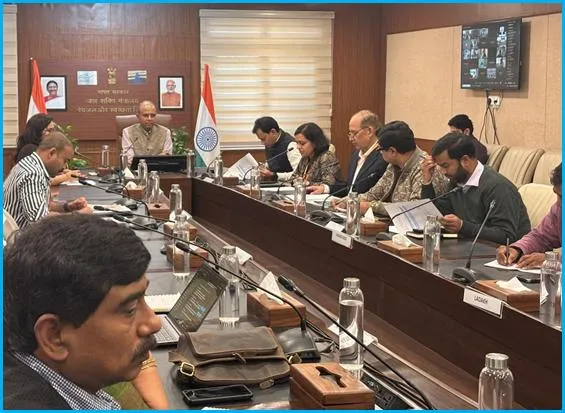
The Department of Drinking Water and Sanitation (DDWS) conducted the third edition of the District Collectors’ Peyjal Samvad, aimed at strengthening district-level engagement and improving the quality and sustainability of drinking water services.
Under the theme “From Grassroot to Forefront”, discussions addressed service delivery performance, infrastructure functionality, source sustainability, water quality, and last-mile governance. District presentations focused on data-backed insights rather than procedural updates.
The event, held through a virtual conference, was chaired by Secretary of DDWS, Shri Ashok K.K. Meena. He stated that while the creation of assets marks an important milestone, the key challenge remains ensuring that quality water is delivered daily, thereby building community trust. He highlighted that effective operation and maintenance is crucial, with Gram Panchayats playing a central role as the institutions closest to the population.
Smt. Ankita Chakravarty, Deputy Secretary-NJJM, noted that over 530 District Collectors have shared recordings of their DWSM meetings, covering issues such as source sustainability, operation and maintenance, leakages, tariffs, and water quality. She added that more than 85,000 Panchayats have accessed the Panchayat Dashboard to monitor data such as household water coverage, scheme functionality, and water quality results. She stated that access to information enables Panchayats to better manage their systems. The recent Sujal Gram Samvad indicated that Panchayat members are willing to take responsibility when provided with information, training, and support.
Presentation on Commissioning and Handing Over Protocol
Shri Sumit Priyadarshi, Deputy Advisor-NJJM, delivered a presentation on the Commissioning and Handing Over Protocol for Rural Water Supply Schemes. The session outlined a structured four-phase validation framework to ensure the quality, transparency, and sustainability of Rural Piped Water Supply Schemes (RPWSS).
Four-Phase Commissioning Framework
- Pre-Commissioning Documentation: As-built drawings, defect assessment, and design compliance.
- System Testing: Pressure testing, water quality verification, disinfection, and flow and capacity testing.
- Trial Operations: 7-14 days of continuous evaluation under real conditions.
- Final Documentation: Commissioning reports, manuals, certifications, and digital integration into platforms such as JJM-WQMIS and PM Gati Shakti.
The Handing Over Protocol, released earlier this month by Union Minister for Jal Shakti Shri C.R. Patil, was discussed. It establishes a uniform process for transferring completed schemes to Gram Panchayats and Village Water and Sanitation Committees (VWSCs), focusing on governance readiness, O&M training, transparent financial systems, BIS-compliant water quality checks, and community-led oversight. The formal Handover Day, celebrated as Jal Arpan Diwas, includes participatory activities such as Jal Bandhan, Pledge Ceremony, and Cultural Programmes to reinforce community ownership and long-term management of local water systems.
District Presentations Highlight Local Innovations
Deputy Commissioners and District Magistrates from five districts shared their field experiences, achievements, and strategies to strengthen rural water service delivery.