The Story of Ram Mandir
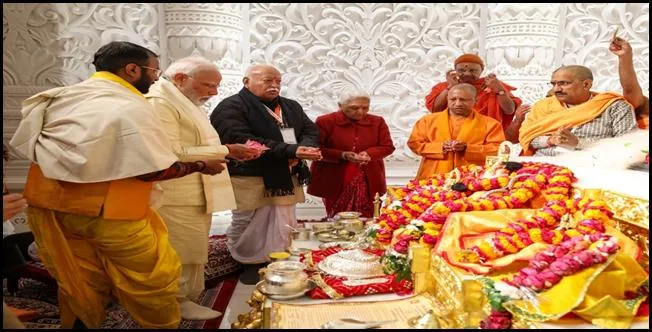
“This grand Ram Mandir will witness – India’s flourishing, India’s rise, this grand Ram Mandir will witness – India’s prosperity and Viksit Bharat.”
Prime Minister Narendra Modi (at the consecration ceremony of Ram Mandir at Ayodhya, January 22, 2024)
Introduction
When the early morning sun reaches the ancient city of Ayodhya, it brings into view more than carved spires and sandstone columns. It highlights a narrative that has influenced India’s cultural identity for generations. The Ram Temple, now fully completed, represents not only an architectural achievement but also the culmination of enduring devotion.
For many across the world, Ayodhya has long been regarded as the birthplace of Lord Ram. The proposal for a temple at this site has been deeply connected to India’s cultural beliefs, shaping its spiritual significance for devotees globally.
On November 25, 2025, Prime Minister Narendra Modi will conduct the Hindu ritual of Dhwaja Arohan by raising a 22-foot religious flag. According to scriptural tradition, the hoisting of this dhwaja signifies the triumph of dharma over adharma and invites devotees worldwide to join the celebration.
A Brief Contextual History
The events leading to this moment reflect a narrative of commitment, the endurance of civilisational memory, and the restoration of historical justice through legal processes.
The Ram Janmabhoomi Mandir in Ayodhya marks the resolution of a long legal and cultural dispute through India’s democratic framework. On November 9, 2019, the Supreme Court of India issued a unanimous verdict granting the full 2.77-acre disputed site for the temple’s construction, acknowledging the location’s religious importance. This judgment was viewed as an affirmation of reconciliation and constitutional values, enabling the temple’s development under the Shri Ram Janmabhoomi Teerth Kshetra Trust, approved by the Government of India on February 5, 2020.
Construction began on August 5, 2020, when Prime Minister Narendra Modi conducted the Bhoomi Pujan and laid the foundation stone. He noted that the occasion marked the conclusion of centuries of expectation and added that the temple would influence future generations while supporting regional growth through better connectivity and economic activities.
The Shri Ram Janmabhoomi Mandir is built in the Nagara architectural style, supported by 392 pillars and featuring 44 entrance gates. Its walls and pillars contain detailed carvings of Hindu deities. The Garbha Griha on the ground floor houses the childhood idol of Bhagwan Shri Ram, Shri Ramlalla.
The Ram Lalla idol is installed in the main sanctum on the ground floor and is approached via 32 steps from the eastern Singh Dwar. The complex consists of five mandaps, including Nritya, Rang, Sabha, Prathana, and Kirtan, designed for devotional activities. Restorations include the ancient Shiv Mandir at Kuber Tila and the historical Sita Koop well.
The Shri Ram Janmabhoomi Teerth Kshetra represents India’s civilisational continuity and the strength of faith supported by legal institutions. The structure revives Ayodhya’s spiritual heritage while aiding comprehensive development, including improvements such as the Maharishi Valmiki International Airport and upgraded access routes that support pilgrimage and economic progress.
Ram Mandir: Global Resonance
The Ram Mandir in Ayodhya reflects the dedication of artisans who worked through extreme conditions, expressing national sentiment surrounding the temple.
Celebrations related to the temple’s construction have extended beyond India. Trinidad and Tobago is progressing with plans to build a Ram Mandir in Port of Spain after unveiling a replica of Ayodhya’s Ram Lalla idol there in May 2025. These developments demonstrate a combination of spiritual commitment and cultural expression, contributing to religious tourism and pilgrimage.
The temple’s design is by Shri Chandrakant Sompura of Ahmedabad, with construction carried out by Larsen and Turbo and advisory support from Tata Consulting Engineers.
“This is a temple of national consciousness in the form of Ram. Lord Ram is India’s faith, foundation, idea, law, consciousness, thinking, prestige and glory.”
Prime Minister Narendra Modi (on the occasion of Ram Lalla’s Pran Pratishtha ceremony at Ayodhya, January 22, 2024)
The project blends traditional craftsmanship with advanced engineering. Experts from institutions including IIT Madras, IIT Delhi, IIT Bombay, and IIT Guwahati have contributed to building the stone structure designed to last a thousand years.
The temple also includes modern facilities for visitors of all ages, such as a Pilgrimage Facility Centre, accessibility ramps, and emergency medical services. Solar panels form part of the complex, aligning with Ayodhya’s approach to sustainable pilgrimage.