
India’s AI Revolution: Preserving 22 Languages Digitally
AI-Powered Platforms for Linguistic Inclusion
India’s linguistic diversity, with 22 Scheduled Languages and numerous tribal dialects, is being integrated into its digital infrastructure. The Government of India is leveraging AI, Natural Language Processing (NLP), and machine learning to create scalable language solutions that democratize access to digital services.
Bhashini: Real-Time Multilingual Translation
Bhashini, under the National Language Translation Mission (NLTM), enables real-time translation for 22 Scheduled Languages and tribal languages. It facilitates access to government services, digital content, and promotes digital inclusion through machine translation, speech recognition, and natural language understanding. Key achievements include Sansad Bhashini for AI-powered parliamentary debate translations and citizen engagement.
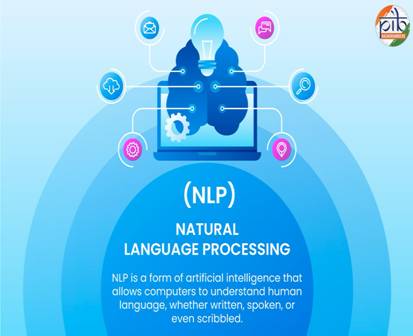
Image Source: Press Information Bureau
BharatGen: Multilingual AI Models
BharatGen develops advanced text-to-text and text-to-speech translation models for all 22 Scheduled Languages. Leveraging data from SPPEL and Sanchika, it powers applications in governance, education, and healthcare, ensuring digital content accessibility across India’s linguistic landscape.
Preserving Tribal Languages with Adi-Vaani
Launched in 2024, Adi-Vaani is India’s first AI-driven platform for real-time translation and preservation of tribal languages like Santali, Bhili, Mundari, and Gondi. By combining speech recognition and NLP, it bridges communication gaps and supports education, governance, and cultural documentation.
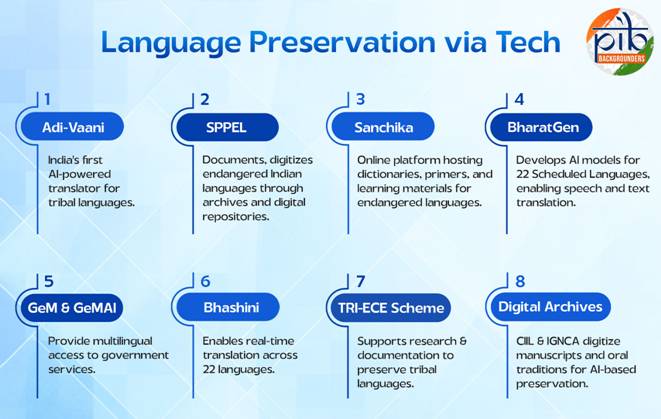
Image Source: Press Information Bureau
Digital Archives and Preservation Efforts
SPPEL, launched in 2013 by the Ministry of Education, focuses on documenting and archiving endangered languages with fewer than 10,000 speakers. Its datasets, including text, audio, and video, support AI and NLP systems. Sanchika, managed by the Central Institute of Indian Languages (CIIL), aggregates dictionaries, primers, and multimedia for Scheduled and tribal languages, aiding AI model training and cultural preservation.
TRI-ECE Scheme
The Tribal Research, Information, Education, Communication and Events (TRI-ECE) scheme supports AI-based tools for translating English/Hindi into tribal languages, ensuring linguistic accuracy and cultural sensitivity through collaboration with Tribal Research Institutes.
Transforming Education with Multilingual AI
AI is revolutionizing India’s education system, aligning with the National Education Policy (NEP) 2020 to promote instruction in the mother tongue. The e-KUMBH portal, developed by AICTE, provides free access to technical books in multiple Indian languages. The Anuvadini app translates educational content, hosted on e-KUMBH, while SWAYAM supports over 5 crore learners with multilingual digital content.
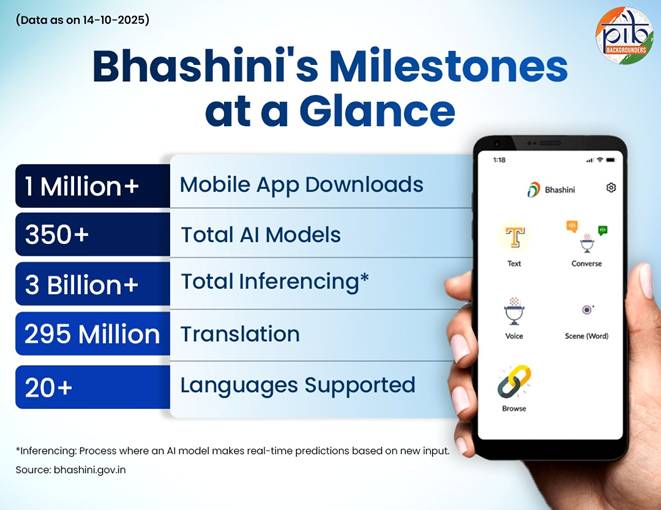
Image Source: Press Information Bureau
Technology Driving the Transformation
India’s multilingual ecosystem relies on advanced technologies like Automatic Speech Recognition (ASR), Text-to-Speech (TTS), Neural Machine Translation (NMT), and Transformer-based Architectures such as IndicBERT and mBART. These systems, supported by extensive datasets from digitized manuscripts and folklore, enable accurate and scalable language solutions.
Conclusion
India’s integration of AI and digital archives ensures that its linguistic heritage remains vibrant and accessible. Platforms like Bhashini, BharatGen, and Adi-Vaani, alongside initiatives like SPPEL and TRI-ECE, empower citizens to engage with digital services in their native languages, positioning India as a leader in multilingual innovation.
Source
Content sourced from the Press Information Bureau, Government of India, published on October 25, 2025.