Union Minister Shri Shivraj Singh Chouhan Launches Nayi Chetna 4.0 Campaign on Gender Equality and Women Empowerment
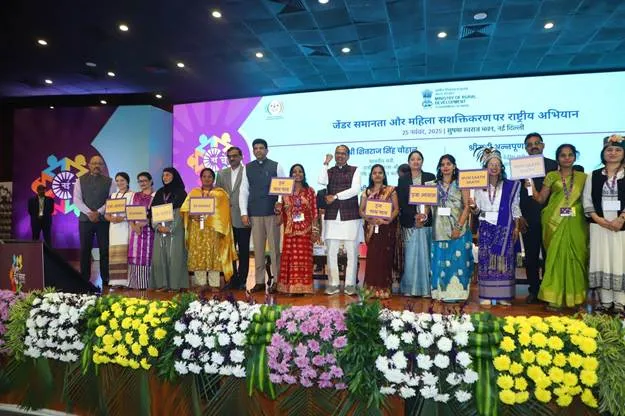
The Union Minister of Rural Development and Agriculture & Farmers’ Welfare, Shri Shivraj Singh Chouhan, launched Nayi Chetna 4.0, the National Campaign on Gender Equality and Women’s Empowerment, at Sushma Swaraj Bhawan, New Delhi. The launch event was attended by the Union Minister for Women and Child Development, Smt. Annapurna Devi, the Minister of State for Rural Development and Communications, Dr. Chandra Sekhar Pemmasani, and the Minister of State for Rural Development, Shri Kamlesh Paswan.
During his keynote address, Shri Shivraj Singh Chouhan reiterated the Prime Minister’s commitment to ensuring that no woman lives in poverty or distress and that every woman achieves dignity, confidence, and prosperity as a Lakhpati Didi. He noted that more than two crore women from Self-Help Groups (SHGs) have already attained this status. Shri Chouhan emphasized that the government continues to work towards strengthening women’s empowerment and expanding opportunities for rural women across the country.
Inter-Ministerial Initiatives
An inter-ministerial joint advisory, signed by eleven Ministries and Departments including the Ministry of Women and Child Development, Department of School Education and Literacy, Ministry of Home Affairs, Ministry of Panchayati Raj, Ministry of Agriculture and Farmers Welfare, Ministry of Social Justice and Empowerment, Ministry of Youth Affairs and Sports, Ministry of Health and Family Welfare, Ministry of Micro, Small & Medium Enterprises, Ministry of Information and Broadcasting, and the Department of Justice, was unveiled at the event. The advisory represents a coordinated “whole of government” approach to address gender-based discrimination and violence.
Smt. Annapurna Devi highlighted the Inter-Ministerial Tripartite MoU–Letter of Intent between the Ministry of Women and Child Development, the Ministry of Law & Justice, and the Ministry of Rural Development. This agreement will support the development of model villages under the Violence-Free Village Initiative, promoting safety, rights, and empowerment opportunities for girls and women in rural India.
Campaign Implementation and Objectives
The month-long campaign, organised by Deendayal Antyodaya Yojana – National Rural Livelihoods Mission (DAY-NRLM) under the Ministry of Rural Development, will run across all Indian States and Union Territories until 23rd December 2025. Led by the extensive SHG network of DAY-NRLM, the campaign is designed as a community-led initiative, or Jan Andolan.
Dr. Chandra Sekhar Pemmasani emphasized the impact of mobilising 10 crore rural women through Self-Help Groups, transforming Nayi Chetna into a strong grassroots movement. He noted that the campaign encourages women to seek support and bring forward issues that have long been suppressed, strengthening community-led efforts towards a violence-free and gender-equitable rural environment.
Shri Kamlesh Paswan highlighted the role of education in addressing gender inequality, describing it as a tool that enables individuals and communities to overcome longstanding barriers.
Two Gender champions from Bihar and Rajasthan shared their experiences of overcoming discrimination and leading change within their communities.
Focus Areas and Outcomes
Nayi Chetna 4.0 aims to strengthen community action against gender-based violence and promote women’s safety, dignity, and economic empowerment in rural India. The campaign focuses on enabling safe mobility, recognising women as key economic contributors, and addressing unpaid care work through shared community responsibility. It also seeks to improve women’s access to assets, credit, skills, and markets, thereby enhancing opportunities for entrepreneurship and livelihoods. By advocating gender-responsive policies and budgets, the initiative ensures that women’s voices influence decision-making at all levels, reinforcing DAY-NRLM’s commitment to equality and inclusive rural development.
The event saw participation from key Ministries and Departments of the Government of India, representatives of State Rural Livelihoods Missions, women members of Self-Help Groups from across the country, Anganwadi workers, and partnering civil society organisations, reflecting a collective commitment to advancing gender equality and rural development.