
India’s Healthcare Revolution: Dr. Singh at UCMS Convocation
Transforming Medical Education in India
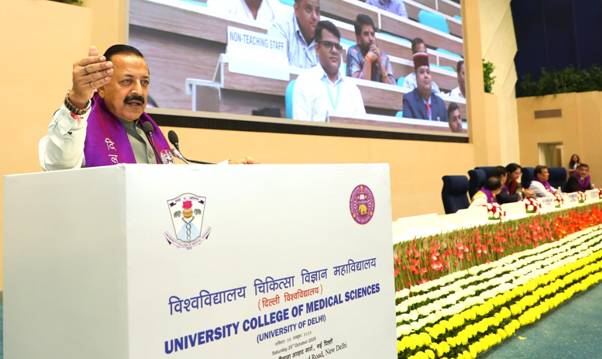
The Minister observed that medical education in India has witnessed a paradigm shift in the past decade with a steep rise in the number of medical colleges and training opportunities. “Ten years ago, there were only about 45,000 undergraduate medical seats; today, the number is close to 1.5 lakh,” he said, noting that the expansion of institutions like AIIMS has democratised access to medical education across regions and enabled more women to pursue medical careers.
Healthcare Accessibility and Affordability
He described the transformation of healthcare delivery as “three-fold — accessible, affordable, and available,” crediting initiatives such as Ayushman Bharat and Jan Aushadhi Kendras for redefining the relationship between the state and the citizen in health matters. Sharing anecdotes from his medical career, Dr. Jitendra Singh highlighted how health insurance in India has evolved to cover pre-existing diseases — a shift he called “one of the most humane innovations” in public health policy.
India’s Global Leadership in Life Sciences
Dr. Jitendra Singh also emphasised the growing global credibility of India’s life sciences sector. “It is this department — the Department of Biotechnology — that has developed the world’s first DNA vaccine for COVID-19, and the HPV vaccine for cervical cancer prevention,” he said, noting that India now supplies indigenous vaccines to over 200 countries.
Breakthroughs in Medical Innovation
Pointing to India’s first indigenous antibiotic ‘Nafithromycin’ and successful gene therapy trials for haemophilia published in the New England Journal of Medicine, Dr. Jitendra Singh said such breakthroughs reflect India’s emergence as a leader in preventive and therapeutic healthcare. He urged UCMS and similar institutions to collaborate with the private sector in conducting advanced clinical trials and research. “The age of working in silos is over,” he remarked, encouraging academic institutions to integrate with industry and government laboratories.
Celebrating UCMS’s Legacy
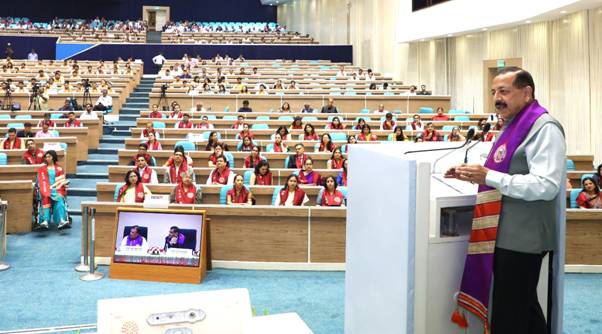
A Souvenir marking the institution’s 54-year journey was released on the occasion, capturing the college’s milestones in medical education, research, and public service. The publication highlighted UCMS’s growing contribution to India’s healthcare ecosystem, particularly its partnership with GTB Hospital in community-based health initiatives.
Dr. Jitendra Singh also presented awards and medals to meritorious students and faculty members in recognition of their academic excellence and contributions to medical research and teaching. The Minister congratulated the awardees and expressed confidence that India’s new generation of doctors would play a decisive role in shaping the nation’s healthcare priorities.
Embracing Technology and Future Challenges
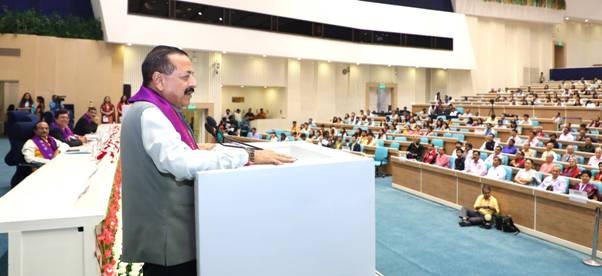
Reflecting on the evolving health challenges, the Minister said today’s doctors must deal with a “bi-phasic disease spectrum” — the coexistence of communicable and non-communicable diseases — alongside an ageing population and rapid technological changes. He noted that the integration of artificial intelligence in medicine, which he himself has experimented with through tele-mobile clinics, is set to redefine diagnostics and patient care. “AI can communicate in the patient’s own language and even provide comfort through human-like interaction,” he said, calling it a hybrid model that combines empathy with innovation.
A Vision for 2047
Dr. Jitendra Singh concluded by reminding young graduates of their unique position in shaping the future of healthcare. “Those receiving their degrees today will be at the prime of their careers when India celebrates 100 years of independence in 2047,” he said. “Destiny has given you this opportunity to be the architects of a healthier, more self-reliant India.”
Source Information
Source: Press Information Bureau (PIB), Delhi. Posted on: 25 October 2025, 4:04 PM.