Dr. Jitendra Singh Highlights BharatGen as India’s First Sovereign Multilingual and Multimodal AI Large Language Model
₹1,293 Crore Government Support Strengthens Development of India’s Sovereign AI Stack
Union Minister of State (Independent Charge) for Science and Technology; Minister of State (Independent Charge) for Earth Sciences; MoS PMO, Personnel, Public Grievances, Pensions, Atomic Energy and Space, Dr. Jitendra Singh hailed BharatGen as India’s first sovereign multilingual and multimodal AI driven Large Language Model during his visit to IIT Bombay.
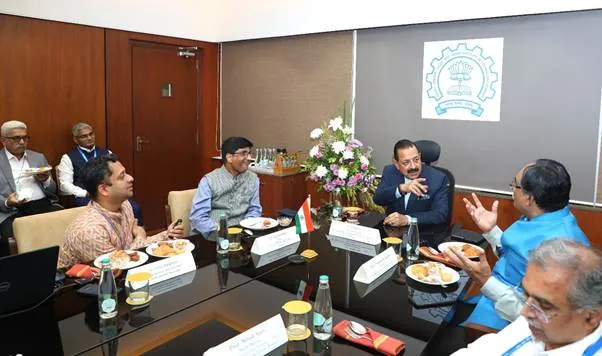
The Minister interacted with the core team of BharatGen, reviewed the ongoing work under the project, and received an extensive presentation.
Briefing on BharatGen’s Vision and Development
During the briefing, Prof. Ganesh Ramakrishnan, Professor-in-Charge of BharatGen, explained how the model operates, its objectives, and its development as a national AI asset. The presentation was attended by Prof. Shireesh Kedare, Director, IIT Bombay; Prof. Abhay Karandikar, Secretary, Department of Science and Technology; and Prof. Kasturi Saha from the Quantum Sensing and Metrology Hub, along with members of the BharatGen team.
Dr. Jitendra Singh was informed that BharatGen represents India’s first sovereign initiative to create a Large Language Model that reflects the nation’s linguistic, cultural and social diversity. Designed to support more than twenty-two Indian languages, BharatGen integrates text, speech and document vision capabilities to enable interaction in formats commonly used by citizens. The Minister was told that the mission aims to develop an inclusive digital future where every language, dialect and regional context is represented in India’s AI systems. The project aligns with the national objective of strengthening India’s role in frontier technologies, an aim often highlighted by Prime Minister Narendra Modi.
Institutional Collaboration and Government Support
The presentation noted that BharatGen is supported under the National Mission on Interdisciplinary Cyber-Physical Systems (NM-ICPS) of the Department of Science and Technology, with ₹235 crore channelled through the Technology Innovation Hub at IIT Bombay. The consortium, led by IIT Bombay, includes IIT Madras, IIT Kanpur, IIIT Hyderabad, IIT Mandi, IIT Hyderabad, IIM Indore, IIT Kharagpur and IIIT Delhi. Dr. Singh observed that the collaboration among these institutions reflects India’s growing capability in deep-tech research.
Bharat Data Sagar and Digital Sovereignty
A major component, Bharat Data Sagar, was described as a significant national data initiative. The Minister was informed that it is being developed to ensure complete ownership and control over India’s digital knowledge resources. Through large-scale, India-focused data collection and curation involving individuals, institutions and organisations, the initiative aims to build datasets representing India’s lived realities, cultural nuances and regional diversity, thereby supporting accurate AI performance and long-term digital sovereignty.
Review of BharatGen Models
The Minister reviewed the models developed under BharatGen. The team presented Param-1, a 2.9 billion parameter foundational text model trained on 7.5 trillion tokens, with more than one-third of the data reflecting Indian content. The project has also produced Shrutam, a 30-million-parameter Automatic Speech Recognition system, and Sooktam, a 150-million-parameter Text-to-Speech model available in nine Indic languages. Additionally, the team showcased Patram, a seven-billion-parameter document-vision model trained on 2.5 billion tokens to interpret complex Indian document formats. Dr. Singh appreciated that these models form a complete AI stack covering text, speech and vision to support governance, industry, education, agriculture, healthcare and digital inclusion.
Demonstrations of Proof-of-Concept Applications
During the interaction, the team demonstrated applications built on BharatGen. These included Krishi Sathi, a voice-enabled WhatsApp advisory service for farmers; e-VikrAI, which generates product descriptions from a single image for small sellers; and Docbodh, a document question-answering platform powered by Patram. The Minister noted that these applications illustrate how AI can enhance daily life and expand access to public services.
Industry and Government Partnerships
The team informed the Minister that BharatGen is being advanced through collaborations with IBM, Zoho, NASSCOM and multiple ministries, including the Ministry of Water and Sanitation (WASH), as well as state governments such as Maharashtra. These partnerships combine domain expertise, local datasets and sectoral needs to support BharatGen’s evolution into a scalable and deployable national AI ecosystem. The Minister observed that this combined effort aligns with the vision of technology that is collaborative, transparent and nationally owned.
Expanded Support Under the India AI Mission
It was also highlighted that BharatGen has received an additional ₹1,058 crore from MeitY under the India AI Mission, transforming it into a nationwide initiative to develop India’s sovereign AI stack. The combined support from DST and MeitY demonstrates the government’s long-term commitment to strengthening India’s role in global AI development. Dr. Singh remarked that such missions show India’s preparedness for the next phase of digital transformation and reflect its capabilities in AI, quantum, space, cyber-physical systems and deep technology.
Minister’s Observations on BharatGen’s National Role
Dr. Singh acknowledged the scale and ambition of BharatGen, stating that it represents a turning point in India’s pursuit of technological self-reliance. He noted that the initiative seeks to ensure that future AI systems reflect the experiences, languages and aspirations of India’s population. He added that efforts like BharatGen support the Prime Minister’s vision of empowering citizens through science and technology by building systems that are inclusive, trustworthy and grounded in local contexts.
The Minister encouraged the BharatGen team to continue developing models that are globally benchmarked and usable across sectors while remaining accessible to citizens. He said that BharatGen will influence India’s digital trajectory and contribute to the country’s role in the global AI landscape.