India Strengthens Global Leadership in Hydrogen Economy
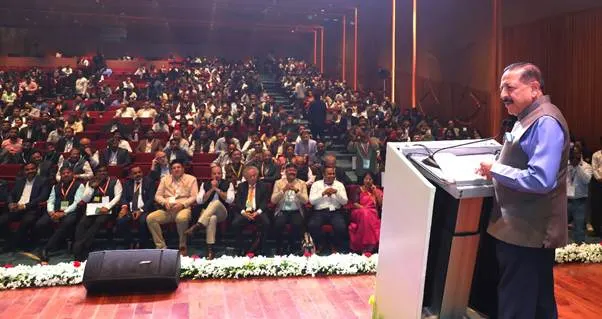
India is emerging as a key player in the global transition toward a self-reliant hydrogen economy, Union Minister of State (Independent Charge) for Science and Technology Dr. Jitendra Singh said at the 3rd International Conference on Green Hydrogen (ICGH–2025) held at Bharat Mandapam, New Delhi.
He emphasized that clean energy is now an economic, technological, and strategic necessity for India’s sustainable growth.
The conference, jointly organized by the Ministry of New and Renewable Energy (MNRE), the Office of the Principal Scientific Adviser, the Ministry of Petroleum and Natural Gas (MoPNG), the Department of Science and Technology (DST), and the Department of Scientific and Industrial Research (DSIR), brought together policymakers, scientists, and industry leaders to shape India’s hydrogen roadmap.
Dr. Singh announced the establishment of four Hydrogen Valleys across the country to demonstrate the complete hydrogen value chain—from production to utilization—with a total investment of ₹485 crore. Of this, ₹169.89 crore will come from the National Green Hydrogen Mission (NGHM) and ₹315.43 crore from industry partners. These Hydrogen Valley Innovation Clusters (HVICs) are designed to serve as real-world laboratories for innovation, standardization, and policy integration.
He also highlighted the newly launched Research, Development and Innovation (RDI) Scheme, unveiled by Prime Minister Narendra Modi on November 3, 2025, with a corpus of ₹1 lakh crore and an allocation of ₹20,000 crore to the DST. The scheme aims to bridge the gap between discovery and deployment, supporting deep-tech and clean energy innovation with active participation from startups and industries.
Dr. Singh underlined the creation of the Anusandhan National Research Foundation (ANRF) as a landmark step to align academia, industry, and government in advancing clean energy, manufacturing, and sustainability. He cited the Mission for Advancement in High-Impact Areas – Electric Vehicle (MAHA–EV) as an example of India’s Atmanirbhar Bharat approach in electric mobility and hydrogen fuel technologies.
Reaffirming India’s role in global clean energy collaboration, Dr. Singh noted that under Mission Innovation 2.0, India and its partners aim to reduce clean hydrogen costs to USD 2 per kilogram and replicate the Hydrogen Valley model worldwide by 2030. He concluded that a self-reliant hydrogen economy will be a cornerstone of India’s journey toward Viksit Bharat 2047.
CSIR and NICDC Join Forces to Boost Industrial Innovation
The Council of Scientific and Industrial Research (CSIR) and the National Industrial Corridor Development Corporation (NICDC) have signed a Memorandum of Understanding (MoU) to integrate scientific research with industrial development across India’s upcoming industrial corridors.
The agreement was signed in New Delhi in the presence of Dr. N. Kalaiselvi, Director General, CSIR, and Shri Rajat Kumar Saini, IAS, CEO and Managing Director, NICDC. The document was formally executed by Dr. Vibha Malhotra Sawhney, Outstanding Scientist and Head, Technology Management Directorate, CSIR, and Mr. Vikas Goel, General Manager (CS & Marketing), NICDC.
The partnership seeks to promote self-reliant, innovation-driven industrial ecosystems aligned with national programs such as Make in India, Startup India, and Aatmanirbhar Bharat. It focuses on establishing R&D hubs, industrial incubators, and innovation centres within smart cities to strengthen collaboration between industry and academia.
Key areas of focus include industrial automation, biotechnology, renewable energy, advanced materials, digital manufacturing, robotics, aerospace, infrastructure engineering, pharmaceuticals, medical devices, agro-processing, and sustainability-linked technologies. The collaboration is expected to enhance productivity, operational efficiency, and environmental sustainability across industries.
IIT Bombay Unveils India’s First Quantum Diamond Microscope
Under the National Quantum Mission (NQM) of the Department of Science and Technology (DST), the P-Quest Group at IIT Bombay has developed India’s first indigenous Quantum Diamond Microscope (QDM) for dynamic magnetic field imaging. The breakthrough, announced during the Emerging Science Technology and Innovation Conclave (ESTIC 2025), marks a major milestone in quantum sensing and has earned India its first patent in this domain.
The announcement was made in the presence of Union Minister Dr. Jitendra Singh, Principal Scientific Adviser Prof. Ajay K. Sood, and DST Secretary Prof. Abhay Karandikar. The QDM, developed under the leadership of Professor Kasturi Saha, is based on nitrogen-vacancy (NV) centres in diamond and enables three-dimensional nanoscale magnetic field imaging.
NV centres—defects in diamond where a nitrogen atom sits next to a vacancy—maintain quantum coherence at room temperature, allowing precise detection of magnetic, electric, and thermal changes. The device uses spin-dependent fluorescence to visualize local magnetic fields, making it highly effective for studying integrated circuits, batteries, microelectronics, and biological systems.
With the rapid evolution of 3D semiconductor architectures and advanced materials, QDM offers a non-destructive tool for mapping buried current paths and multi-layer chip structures. The IIT Bombay team aims to integrate this technology with AI- and ML-based computational imaging to advance applications in chip diagnostics, neuroscience, and geological studies.