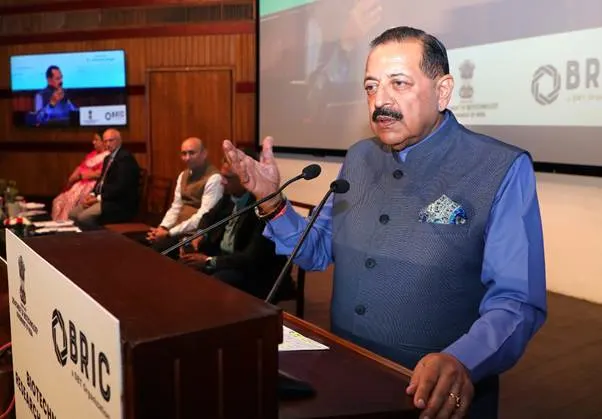
New Delhi, 10 November 2025: India is poised at the forefront of the next industrial revolution, driven by biotechnology, stated Dr. Jitendra Singh, Union Minister of State (Independent Charge) for Science & Technology and Earth Sciences, during the second Foundation Day celebration of the Biotechnology Research & Innovation Council (BRIC) at the National Institute of Immunology (NII).
India’s Dedicated Biotechnology Policy and BRIC Integration
Dr. Singh highlighted that India is among the few countries with an exclusive Biotechnology policy, BioE3, which has positioned the nation as a global frontrunner in bio-innovation. He praised the Department of Biotechnology (DBT) for evolving into a dynamic, integrated scientific ecosystem and emphasized that the consolidation of 14 autonomous biotechnology institutions under BRIC has strengthened coordination, innovation, and impact across India’s biotechnology sector.
The Minister stated that the BRIC integration exemplifies the end of silos in Indian science, promoting collaboration across biotechnology, medical research, agriculture, and data-driven science. BRIC now partners with IITs, medical institutions, and private industry to accelerate innovation.
BRIC–BIRAC Entrepreneur-in-Residence Program and New Facilities
Dr. Singh inaugurated the BRIC–BIRAC Entrepreneur-in-Residence (EIR) Program and launched the nation’s first Non-Human Primate ABSL-3 Facility. He cited BRIC and BIRAC as successful public-private partnership models that have become benchmarks even in global forums.
Key Achievements and Bioeconomy Growth
India’s bioeconomy has grown from USD 10 billion to over USD 130 billion and is projected to reach USD 300 billion in the coming years. Dr. Singh noted significant milestones including advanced biosafety facilities, breakthroughs in Hemophilia gene therapy, and India’s rising global ranking in biotechnology. He also highlighted India’s transformation during the pandemic from a recipient of global healthcare to a provider of preventive healthcare solutions.
BRIC Institutions’ Achievements
Dr. Rajesh S. Gokhale, Secretary of DBT and DG of BRIC, reported that over the past three years, BRIC institutions achieved:
| Category | Number |
|---|---|
| Publications | 3,190 |
| Patents | 107 |
| Technologies Commercialized | 13 |
| PhD Scholars | 2,578 |
| Post-doctoral Fellows | 678 |
BRIC ranks number one in biological sciences in India, according to Nature’s Pringles Index. The recently launched Design for BioE3 Challenge received 510 applications, 431 from BRIC institutions. Additionally, a BRIC Bio-Enterprise Innovation Park has been established on a 200-acre campus in Faridabad to foster innovation-led entrepreneurship.
Future Outlook for Indian Biotechnology
Concluding the event, Dr. Jitendra Singh expressed optimism about the future of Indian biotechnology, stating, “The best of DBT is yet to come — and so is the best of India. The road to Viksit Bharat will pass through the corridors of DBT.”
Attendees and Dignitaries
The event was attended by Dr. Kalaivani Ganesan, Scientist-F DBT/Nodal Officer, BRIC; Dr. Anand Deshpande, Founder Chairman and MD of Persistent Systems & Co-Chair, Governing Body, BRIC; Prof. Santishree Dhulipudi Pandit, Vice-chancellor of Jawaharlal Nehru University, New Delhi; and Dr. P. M. Murali, President of the Council of Presidents of ABLE and Founder & Chairman of Jananom Pvt. Ltd., along with other dignitaries.