
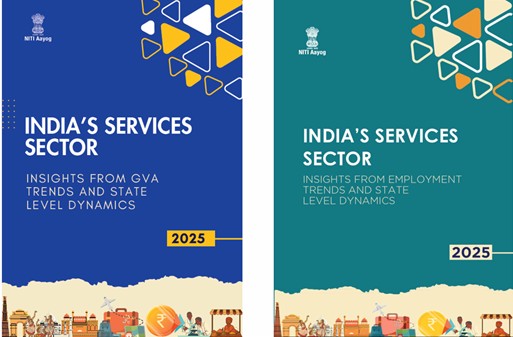
Imagine the services industry as the quiet engine keeping India’s economy humming along. That is exactly what two fresh studies from NITI Aayog bring into sharp focus. Released on 28 October 2025, these documents dig deep into how services are shaping output and jobs right across the country. They go beyond plain numbers to show which states are gaining ground and where the real hurdles lie.
What the First Report Says About Output and Regional Balance
The opening study looks at gross value added, or GVA, from services at both national and state levels. Services now make up close to 55 percent of India’s total GVA for the financial year 2024-25. That is a big slice of the pie. What stands out is how this growth is slowly spreading out. States that started with smaller shares are starting to close the gap with the front-runners. Differences between states have grown a little, but the catching-up trend points to a more even spread over time.
Think of it like a relay race where the slower runners are picking up speed. This shift matters because it shows services are not just boosting big cities anymore. Smaller regions are finding their footing too. The report suggests a few practical steps to keep this momentum going. At the national level, pouring money into digital networks, better transport links, fresh ideas, banking access, and training programs can help services branch out into new areas.
For individual states, the advice is to play to local strengths. Build strategies that fit the ground reality, strengthen local institutions, link services with factories and farms, and grow clusters in cities and towns. These ideas aim to make services a stronger pillar for balanced growth everywhere.
Why Regional Convergence Feels Like Good News
When lagging states start matching the leaders in services share, it signals healthier regional development. It means jobs and income are not piling up in just a handful of places. Families in less advanced areas get better chances to earn and grow. The report calls this an early sign of inclusive progress, something India needs to hit its long-term goals.
The Second Report: A Close Look at Jobs in Services
The companion study turns the lens on employment. Services have long been the biggest job creator in India, especially after the pandemic slowdown. Yet the picture is not all rosy. The sector has two faces. One side includes modern areas like IT, finance, and telecom that pay well and compete globally, but they do not hire huge numbers. The other side covers traditional trades, retail, and small transport businesses that soak up millions of workers, though most jobs stay informal and low-paid.
Women, rural youth, and people in remote states often miss out on the better opportunities. Education levels and skill gaps add to the divide. The report maps these patterns across sub-sectors, genders, locations, and job types to give a full view of the workforce.
Four Clear Steps to Fix Employment Gaps
To turn things around, the study lays out a straightforward four-point plan. First, bring formal rules and safety nets to gig workers, self-employed people, and tiny firms. Second, offer targeted training and internet access so women and village youth can join high-growth fields. Third, invest in skills for new industries and green jobs. Fourth, set up service hubs in medium and small cities to spread opportunities beyond metros.
These moves can lift job quality while keeping the sector as a job magnet. The idea is to make services a reliable path to decent, steady work for everyone.
How States and Businesses Can Use These Findings
Both reports hand over ready toolkits. State governments can craft plans that match their unique mix of talent and resources. Industry groups can spot where to invest in training or infrastructure. Together, deeper digital reach, a larger pool of skilled workers, innovation hubs, and tighter links across supply chains can push India ahead as a top services player worldwide.
The launch event saw top officials, state representatives, business leaders, and academics come together in Delhi. NITI Aayog CEO B.V.R. Subrahmanyam led the rollout, joined by member Arvind Virmani and Chief Economic Adviser V. Anantha Nageswaran. The gathering underlined how seriously policymakers view services as the backbone of future growth.
Linking Services to the Bigger Dream
India wants to be a developed nation by 2047. Services sit at the heart of that vision. They drive half the economy already and employ the most people. Making this sector more productive, fair, and widespread is key to lifting living standards nationwide. The reports mark a starting point, offering data-backed ideas that anyone from a state planner to a startup founder can pick up and run with.
In short, services are not just about call centers or software parks anymore. They touch transport, healthcare, education, tourism, and countless local trades. Nurturing them smartly can create millions of better jobs and pull every corner of the country forward.
If you run a small business or work in policy, these insights are worth a close read. They show where the opportunities lie and what needs fixing to keep the growth engine revving smoothly.
Focused keyword: niti aayog services sector reports
Meta description: NITI Aayog Services Sector Reports reveal balanced growth in GVA and employment trends across states, highlighting convergence and policy needs.