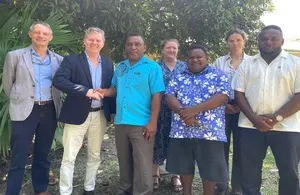
Honiara, 11 November 2025: The British High Commissioner to Solomon Islands and Nauru, His Excellency Paul Turner, has announced a series of new UK-backed technical assistance projects in the lead-up to the COP30 Summit in Brazil. These initiatives aim to strengthen governance and sustainability in the forestry, mining, and energy sectors of the Solomon Islands.
UK Support for Energy and Natural Resource Reforms
During meetings with Permanent Secretaries and senior officials from the Ministries of Finance, Energy & Mines, and Forestry, Turner emphasized that the Solomon Islands is “at the crossroads” in managing its natural resources. He noted that while challenges like rising sea levels are beyond local control, sustainable management of forests, minerals, and energy resources remains within the government’s power to reform.
The British High Commission confirmed that teams of UK experts will collaborate with government departments to develop transparent systems for managing forestry and extractives. The UK will also assist in establishing a new Independent Energy Regulator to enable the entry of more renewable energy providers into the Solomon Islands’ market.
Lessons from Logging: Building a Sustainable Forestry Future
Addressing forestry management, Turner highlighted the urgent need for Solomon Islands to learn from the overexploitation of its logging resources. He pointed out that while forestry contributes around 25% of government revenue and 60% of exports, excessive logging is causing irreversible environmental damage.
Turner also reminded that up to 90% of Solomon Islanders rely on forest resources for their livelihoods. To promote sustainability, the UK forestry team will assist in developing new forest management systems, beginning with communities in Malaita and Guadalcanal. Additionally, a new legislative framework will be drafted to strengthen monitoring and enforcement through local rangers.
Strengthening Governance in the Mining Sector
Turner warned that as logging companies shift toward mining, the need for strong governance in the extractives sector has become critical. He welcomed the Solomon Islands Government’s plan to re-join the Extractive Industries Transparency Initiative (EITI), an international body promoting transparency in the global minerals industry. The Solomon Islands had previously exited EITI in 2016.
Under the UK’s partnership with the UNDP, consultations will be held with provincial governments, communities, and mining companies to develop new governance standards. “Strong, robust governance of the mining sector is key to avoiding the mistakes of the logging sector,” Turner said.
Driving Energy Sector Transformation
In the energy sector, the UK is collaborating with the Ministry of Mines and Energy to diversify power generation and allow more Independent Power Providers (IPPs), particularly in solar energy. Currently, Solomon Power dominates electricity generation, with nearly 90% derived from diesel sources.
Turner stated that “diesel is bad for people’s health and wallet,” stressing that the Solomon Islands must transition toward renewable options to address the world’s highest energy prices. The establishment of an Independent Energy Regulator will pave the way for new suppliers, encouraging competition and cleaner energy production.
UK legal experts are already embedded within the Ministry of Energy to develop the necessary legal framework for reform. Turner acknowledged that while the process will take time, it is a vital step toward lowering energy costs and supporting economic growth across the islands.
Commitment to a Sustainable Future
Through these multi-sector reforms, the British High Commission aims to support the Solomon Islands in achieving long-term sustainability, stronger governance, and cleaner energy development. The initiatives align with the broader goals of the COP30 Summit, where the focus remains on global climate action and responsible resource management.