Youth Participation Highlights at IITF 2025
Tradition and Aspiration Converge at the Fair
The 44th India International Trade Fair in New Delhi reflects the theme Ek Bharat Shreshtha Bharat through the presence of young artisans and entrepreneurs representing regions from Bijnor to Madhubani, Alwar to Kutch, and Tunisia. Their participation demonstrates how a new generation is contributing to India’s evolving economic and cultural landscape.
Across the corridors of Bharat Mandapam, these young individuals are presenting more than products. They are continuing family traditions, developing new techniques, and building their own entrepreneurial paths. Their experiences mirror initiatives that support MSME growth, skills development, rural employment, and global market access. Mera Yuva Bharat provides an additional platform that encourages leadership and innovation among young people. At IITF 2025, these efforts converge to provide opportunities on a national and international scale.
The Jaggery Entrepreneur from Bijnor
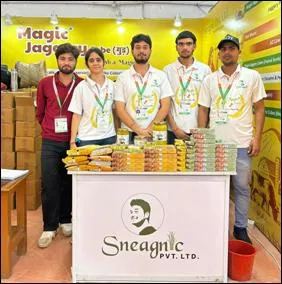
From Bijnor in Uttar Pradesh, 26-year-old Naman Sharma represents a new approach to agro-entrepreneurship. His aim is to modernise the jaggery sector and promote chemical-free products. Coming from a sugarcane-growing family, he decided to remain connected to his roots while many peers sought education abroad. Although he began experimenting in 2018, he formally registered his private limited company in 2021.
Naman works with his younger brother, aged 21, and sister, aged 23. Their initiative supports livelihoods by employing 15 factory workers and 25 women in packaging. This is his first IITF, following positive responses at regional events such as Bijnor Mahotsav and Basant Mahotsav. He is now exploring export opportunities and applying for the Prime Minister’s Employment Generation Program to expand his operations.
The Young Artist Continuing a Padma Shri Heritage
In the Bihar pavilion, 18-year-old Madhuram Kumar Jha from Jitwarpur presents Madhubani paintings. His grandmother is Padma Shri awardee Baua Devi, a prominent figure in the Mithila tradition. Madhuram learned by observing her from a young age, recalling that he would sit beside her and assist as she worked.
He has already travelled to multiple states for exhibitions while managing his academic responsibilities. He mentions that he will prepare for his exams after the fair concludes. Madhuram acknowledges the pavilion for providing recognition and a platform, crediting his grandmother for the visibility he receives. His aspirations include taking Madhubani art to wider audiences and eventually joining the IRS or the Indian Navy.
A Young Potter Sustaining a Family Craft
In the Rajasthan pavilion, 20-year-old Karishma Parjapat represents her family’s pottery work. She describes the process of breaking, melting, and soaking clay before her father shapes and fires it in a kiln. Alongside her studies for a BA in Dausa district, she supports her father, mother, sister, and two workers involved in the craft.
Their participation is supported by the Directorate Women Empowerment, which sponsors their stall. Karishma explains that they apply whenever entries are invited, and their family has been selected twice. Her ability to balance academics with craft work illustrates the increasing involvement of young women in traditional art sectors. The terracotta products displayed at the fair highlight Rajasthan’s artisanal heritage as carried forward by younger generations.
A Centuries-Old Craft Renewed in Kutch
From Kutch in Gujarat, 26-year-old Luhar Javed Abdulla works with copper bells linked to an 800- to 900-year-old craft tradition, with his own family engaging in the work for roughly 400 years. Previously used as cowbells, these items have been adapted into musical instruments, wind chimes, and decorative doorbells.
The family business employs 20 people, many of whom are women. Their products have reached international audiences, with a cousin regularly presenting them in exhibitions in the United States. Javed represents artisans who innovate within traditional practices, tailoring products to modern preferences while maintaining long-standing metalworking techniques. For him, IITF is both a market and a space to present cultural heritage.
International Youth Participation at the IITF Pavilion
The international pavilion at IITF 2025 features 12 countries, reflecting the fair’s growth as a global platform connecting cultures and young entrepreneurs. Among the international participants is 26-year-old Ahmad Shahid from Tunisia, who brings hand-painted ceramics, olive-wood items, lamps, and decorative pieces.
Ahmad learned his family’s craft and now operates a small export-focused business. He notes that visitors are curious about the methods used in creating the products. For participants like him, the fair is an opportunity to understand local preferences, meet wholesalers, explore collaborations, and engage with India’s handicraft and lifestyle market.
Youth Driving Change at IITF 2025
IITF 2025 reflects the spirit of Ek Bharat Shreshtha Bharat through the participation of young artisans, entrepreneurs, and innovators. Their contributions show how regional talent can be supported and showcased at a wider level. For many, the fair offers a significant platform to present their craft, learn about markets, and interact with diverse audiences.
Their experiences illustrate how empowered youth can shape progress by bringing forward traditions, ideas, and innovations that contribute to the nation’s cultural and economic narrative.