India Enters New Era of Defence Innovation, Raksha Mantri Highlights Role of Young Entrepreneurs at Swavlamban 2025
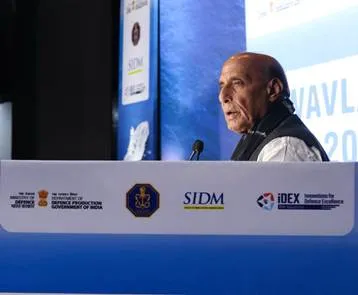
“India must remain proactive, ahead of the curve and future-ready in today’s rapidly-evolving world,” said Raksha Mantri Shri Rajnath Singh while addressing participants at the fourth edition of the Indian Navy’s Swavlamban seminar in New Delhi on November 25, 2025. He emphasized the importance of a self-reliant domestic supply chain for ensuring cost efficiency, reliability, and strategic independence.
Speaking to start-ups, MSMEs, academia, industry partners, and venture capitalists, Shri Rajnath Singh stated, “India is entering a golden era of defence innovation, and its foundation is being laid by our innovators and young entrepreneurs who are integrating economic strength, strategic thinking, and technological advancements.” He highlighted that the nation must adopt a proactive approach rather than a reactive one amid the changing geopolitical landscape.
The Raksha Mantri credited innovators for helping India emerge as a builder, creator, and leader rather than merely a buyer. He noted that the indigenisation movement is driven by the efforts of all stakeholders and is enabling India to transition from being a technology importer to a technology exporter. “If India is rising as a maritime power today, it is due to the contribution of our innovators along with the Navy,” he said.
Private Sector and Profit-Plus Approach
Shri Rajnath Singh urged the private sector to adopt a profit-plus approach, combining monetary profit, nationalism, a sense of duty, and strategic responsibility. He emphasized that economic activity should be treated as a national mission and encouraged the private industry to expand its role in production, technology, design, and innovation while prioritizing national interests. He also called for increasing the private sector’s contribution to defence manufacturing to 50% or more in the coming years.
Reducing Import Dependency
The Raksha Mantri highlighted the financial burden of maintaining, repairing, and supplying spares for defence equipment imported from abroad. He stressed the need to minimize import dependency and develop a strong domestic supply chain. “If we strengthen local manufacturing of components and subsystems, our indigenous content will increase rapidly. This will enhance capability, ensure cost efficiency, reliability, and strategic independence,” he said. He underscored that defence innovation, indigenous design, advanced manufacturing, and strategic autonomy will become core strengths of future development.
Collaboration and Innovation
Shri Rajnath Singh encouraged the private industry to identify potential platforms, disruptive technologies, and innovations, assuring full government and defence support to address any challenges. “India is changing, the defence sector is changing, geopolitics is changing. We too must change our thinking. We must march ahead at an unprecedented pace,” he said.
Chief of the Naval Staff Admiral Dinesh K Tripathi noted that Swavlamban has grown significantly, from 800 participants in its first edition to 3,000 last year. He highlighted that of the 565 iDEX challenges announced, the Indian Navy accounts for 35%, with Swavlamban playing a central role. He stated that innovations by start-ups and MSMEs have strengthened the Navy and expanded procurement opportunities across the Armed Forces.
Event and Exhibition Highlights
Swavlamban, organized by the Naval Innovation and Indigenisation Organisation in collaboration with the Society of Indian Defence Manufacturers and Defence Innovation Organisation, provides a platform to showcase indigenous technologies and foster collaboration. The seminar featured a technology exhibition displaying innovations in AI, autonomous systems, communication technologies, quantum computing, stealth solutions, and smart ordinances. Approximately 80 MSMEs and start-ups presented prototypes and solutions for operational and strategic naval requirements. Raksha Mantri visited the exhibition and reviewed the equipment on display.
MoU on Armament Systems
An MoU was signed among the Indian Navy, IIT Madras, and Apollo Micro Systems to integrate academic R&D, naval expertise, and manufacturing capabilities for indigenous development and production of armament systems. The signing took place in the presence of Shri Rajnath Singh.
SARATHI App Launch
Shri Rajnath Singh launched the System for Armament Review, Analysis, Tracking, Handling, and Indigenisation (SARATHI), a knowledge management tool covering the entire lifecycle of ammunition, developed by the Centre for Development of Advanced Computing, Chennai.
Innovathon and Interactive Sessions
Innovathon, a naval hackathon, was launched to engage students, researchers, technologists, and developers in addressing maritime operational challenges. The event also included interactive sessions with Naval and Defence Attachés, presentations by the Technology Development Acceleration Cell, and a fireside chat on innovation and self-reliance to promote a sustainable defence entrepreneurship ecosystem.
Other Highlights
The seminar included the felicitation of 10 iDEX winners and the release of key documents including the Compendium of Indian Naval Technological Challenges & Problem Statements, Swavlamban 4.0 Document, and Armament Indigenisation Compendium. Chief of Defence Staff General Anil Chauhan, Secretary (Defence Production) Shri Sanjeev Kumar, and Secretary Department of Defence R&D & Chairman DRDO Dr Samir V Kamat were present at the event.