Thailand places decent work at the center of trade competitiveness
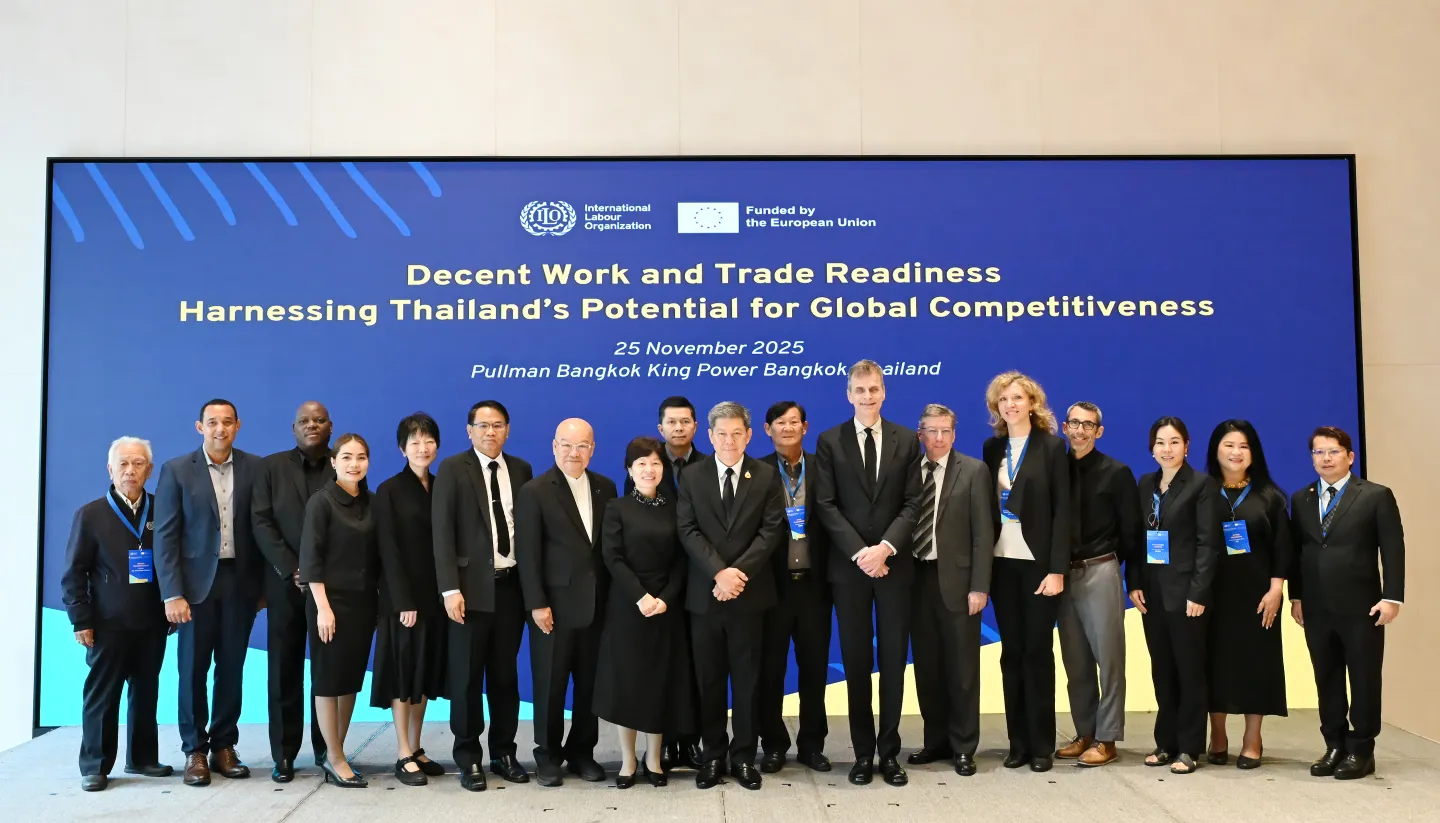
National dialogue focuses on sustainable competitiveness and labour standards
A national dialogue held on 26 November 2025 examined Thailand’s approach to enhancing sustainable competitiveness and advancing labour standards in a shifting global trade environment. The event, titled “Decent Work and Trade Readiness: Harnessing Thailand’s Potential for Global Competitiveness in the Era of Changing Trade Patterns,” was organized by the Government of Thailand in collaboration with the International Labour Organization and the European Union.
The dialogue brought together more than 60 representatives from government ministries, workers and employers organizations, the EU Delegation to Thailand, academia and civil society. Discussions explored the connection between trade, labour standards and sustainability, the incorporation of Just Transition principles into Thailand’s Bio-Circular-Green Economy Model, and current trends in labour provisions in free trade agreements.
Perspectives from government and international partners
Saksinath Sonthisakyotin, Assistant Permanent Secretary at the Ministry of Labour, noted that Thailand has shown resilience amid global trade uncertainty and is positioned to benefit from emerging opportunities. Sonthisakyotin stated that aligning trade, employment and social policy is essential to ensure competitiveness and equity. The dialogue was described as a step toward policy coherence and shared prosperity.
Xiaoyan Qian, Director of the ILO Decent Work Technical Support Team for East and South-East Asia and the Pacific and the Country Office for Thailand, Cambodia and the Lao People’s Democratic Republic, highlighted Thailand’s commitment to linking economic progress and decent work with social justice. Qian expressed appreciation for the leadership of the Ministry of Labour and the support of the European Union in advancing the dialogue, emphasizing efforts to strengthen trade competitiveness through human-centred and sustainable development.
Andreas Roettger, Head of the Foreign Policy Instruments Regional Team for Asia and the Pacific at the EU Delegation to Thailand, underscored the partnership between the EU, the ILO and the Government of Thailand. Roettger said the European Union supports Thailand’s pursuit of inclusive and sustainable growth, noting that collaboration can help ensure that the advantages of free trade are tied to labour rights, inclusion and the well-being of both workers and employers.
Sessions address trade competitiveness and labour trends
The event included thematic sessions on reducing barriers to trade competitiveness, just transition and green jobs, and current economic and labour market aspects of trade competitiveness. Technical specialists from the ILO, government bodies and social partners discussed how compliance with decent work standards can bolster Thailand’s international standing and attract quality investment.
Participants confirmed their continued commitment to improving consistency between trade and labour policies. With support from the European Union, the ILO will maintain engagement with government, employer and worker representatives in Thailand to follow up on the dialogue’s recommendations. This includes considering potential technical cooperation activities and sharing knowledge with other countries in the Asia-Pacific region.
Trade performance and project background
According to the Ministry of Commerce, Thailand’s exports reached US$300.53 billion in 2024, marking an increase of 5.4 per cent from the previous year, while imports rose by 6.3 per cent.
The National Policy Dialogue forms part of the Managing a Decent Future of Work Together – Asia and the Pacific project, also known as the Future of Work: APAC initiative. Funded by the European Commission’s Service for Foreign Policy Instruments and implemented by the ILO, the four-year project running from 2025 to 2029 supports mutual learning to advance labour standards in response to major trends including technological change, demographic shifts, climate transition and changing trade dynamics.