Prime Minister inaugurates Skyroot’s Infinity Campus in Hyderabad
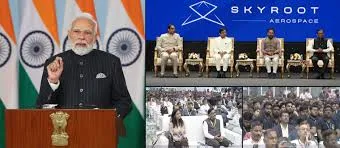
Vikram-I orbital rocket unveiled; PM highlights expanding role of youth in India’s space sector
Prime Minister Shri Narendra Modi inaugurated Skyroot’s Infinity Campus in Hyderabad, Telangana through video conferencing. Addressing the gathering, he noted that the country is witnessing an expanding opportunity in the space sector and said India’s space ecosystem is progressing as private participation grows. He stated that Skyroot’s Infinity Campus represents new ideas, innovation, and the strength of young talent, and highlighted that the innovation, risk-taking ability, and entrepreneurship of India’s youth continue to rise. He added that the event reflects how India aims to strengthen its position in the global satellite launch ecosystem. The Prime Minister conveyed his best wishes to Shri Pawan Kumar Chandana and Shri Naga Bharath Daka, noting that the entrepreneurs inspire young space innovators across the country. He said they trusted their own abilities, accepted challenges, and their success today makes the nation proud.
Recalling the beginning of India’s space journey, Shri Modi said that while the early stage had limited resources, the country’s ambitions were always high. He said India’s progress from transporting rocket parts on a bicycle to developing reliable launch vehicles shows that the scale of aspirations is defined by determination rather than resources. He said ISRO has strengthened India’s space efforts for decades and that its credibility, capacity, and value have helped the nation secure a distinct place in the sector.
Speaking about changing global needs, the Prime Minister said the space sector now supports communication, agriculture, marine monitoring, urban planning, weather forecasting, and national security. He said this is why major reforms were introduced, including opening the space sector to private innovation and developing a new Space Policy. He noted that efforts were made to integrate startups and industry with innovation and that IN-SPACe was created to provide ISRO facilities and technology to startups. He said that in the past six to seven years, India has developed an open, cooperative, and innovation-driven space ecosystem, which is reflected in the day’s programme.
The Prime Minister said India’s youth consistently prioritise national interest and use every opportunity well. He stated that when the space sector was opened, young people, especially the Gen-Z generation, stepped forward enthusiastically. He said more than 300 space startups are now contributing to India’s space future, often beginning with small teams working from limited resources but with strong determination. He said this spirit has supported the growth of India’s private space sector, and noted that Gen-Z engineers, designers, coders, and scientists are developing new technologies in propulsion systems, composite materials, rocket stages, and satellite platforms. He said India’s private space talent is gaining recognition globally and that the country is becoming an appealing destination for global investors.
Shri Modi said the global demand for small satellites is increasing and launch frequencies are also rising. He said new companies are entering the market to offer satellite services and noted that space has become a strategic asset. He stated that the global space economy is expected to grow significantly in the coming years, creating important opportunities for India’s youth.
The Prime Minister said India possesses capabilities in the space sector that only a few nations have, mentioning experienced engineers, a strong manufacturing ecosystem, advanced launch sites, and a mindset supportive of innovation. He said India’s space capability is cost effective and reliable and that the world holds strong expectations from the country. He noted that international companies wish to manufacture satellites in India, use launch services, and explore technology partnerships, and said the nation must make full use of this opportunity.
Shri Modi said the changes in the space sector are part of a broader startup movement underway in India. He said that in the past decade, startups have expanded across sectors including FinTech, AgriTech, HealthTech, ClimateTech, EduTech, and DefenseTech, with India’s youth, especially Gen-Z, developing solutions in each field. He said the creativity and positive attitude of the Gen-Z generation can motivate young people globally. He stated that India is now the world’s third-largest startup ecosystem and recalled that startups were once located mainly in major cities, whereas now they are emerging from smaller towns and villages. He said the country has more than 1.5 lakh registered startups, with many achieving unicorn status.
The Prime Minister said India is moving beyond apps and services and advancing toward deep-tech, manufacturing, and hardware-based innovation. He highlighted developments in the semiconductor sector and said government initiatives are strengthening the foundation of India’s technological future. He noted that semiconductor fabrication units, chip manufacturing, and design hubs are developing across the country and said that India is building an integrated electronics value chain from chips to systems. He said this supports the objective of self-reliance and also strengthens India’s position in the global supply chain.
Shri Modi said that reforms continue to expand, and as space was opened to private innovation, India is now progressing toward opening the nuclear sector. He said a strong role is being created for private industry in this area, which will open opportunities in small modular reactors, advanced reactors, and nuclear innovation. He said this step will aid India’s energy security and technological leadership.
The Prime Minister said the future will depend on current research and that the government is focused on offering opportunities for young researchers. He noted the establishment of the National Research Foundation to support modern research and highlighted that the One Nation, One Subscription initiative has made access to international journals simpler for students. He said the ₹1 lakh crore Research, Development, and Innovation Fund will support young people nationwide. He added that more than 10,000 Atal Tinkering Labs have been set up to encourage research and innovation among students, and work is underway to establish 50,000 additional labs. He said these efforts are building the groundwork for new innovations and that the coming era belongs to India, its youth, and their ideas. He recalled speaking on Space Day about India’s aspirations and said that in the next five years, India will expand its launch capacity and create five new unicorns in the space sector. He said the progress of the Skyroot team shows that India will meet its goals.
The Prime Minister assured young people, startups, scientists, engineers, and entrepreneurs that the government will continue to support them. He congratulated the Skyroot team and conveyed his best wishes to those contributing to India’s space advancement. He urged everyone to work toward making the 21st century the century of India, on Earth and in space.
Union Minister Shri G Kishan Reddy attended the event along with other dignitaries.
Background
Skyroot’s Infinity Campus is a facility with around 200,000 square feet of workspace for designing, developing, integrating, and testing multiple launch vehicles, with the capability to build one orbital rocket each month.
Skyroot is a private space company founded by Pawan Chandana and Bharath Dhaka, alumni of Indian Institutes of Technology and former ISRO scientists. In November 2022, the company launched its Vikram-S sub-orbital rocket, becoming the first Indian private company to send a rocket to space.
The growth of private space enterprises reflects the impact of reforms introduced in recent years, strengthening India’s standing as a capable global space participant.