
Important Facts of the News
- National Beekeeping and Honey Mission (NBHM) is a Central Sector Scheme supporting scientific beekeeping.
- Total mission outlay is Rs. 500 crore for FY 2020-21 to FY 2025-26.
- Mission is implemented by the National Bee Board (NBB).
- NBHM operates through three Mini Missions focused on productivity, post-harvest systems, and research.
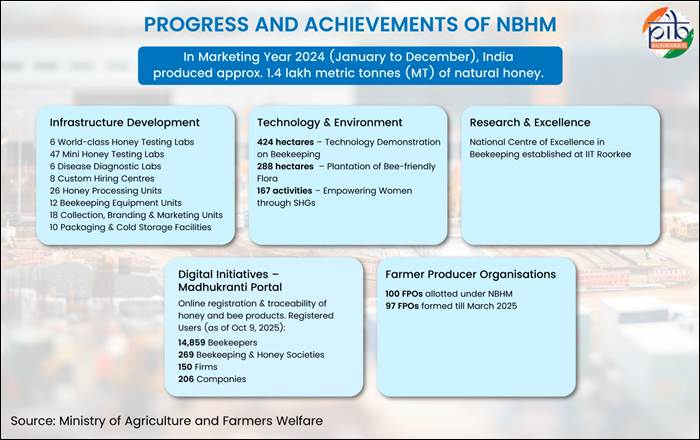
- India produced approx. 1.4 lakh MT of natural honey in 2024.
- India exported approx. 1.07 lakh MT honey valued at USD 177.55 million in FY 2023-24.
- India is currently the second-largest global exporter of natural honey.
- Madhukranti portal enables online registration and traceability of honey and bee products.
- 100 FPOs for honey producers have been allocated under NBHM, with 97 already formed by March 2025.
- 6 world-class honey testing labs and 47 mini labs sanctioned nationwide till March 2025.
Overview of the Mission
The National Beekeeping and Honey Mission was launched to expand scientific beekeeping and strengthen honey value chains across India. The mission is designed to encourage farmers and rural households to take up beekeeping as part of integrated farming practices, contributing to improved crop pollination and income stability. With a sanctioned outlay of Rs. 500 crore, the mission functions under the National Bee Board and remains active through FY 2025-26.
Three Mini Missions
Mini Mission I: Productivity Enhancement
This segment focuses on increasing honeybee colonies, improving pollination in crops, and spreading scientific training among beekeepers to raise both honey production and crop yields.
Mini Mission II: Post-Harvest Infrastructure
Support under this segment includes honey processing units, storage facilities, cold chains, marketing systems and value addition. Efforts are directed towards building strong market linkages for bee-based products.
Mini Mission III: Research and Technology
This segment advances region-wise research in beekeeping, disease control, bee genetics, and quality testing. Regional and mini labs are being set up to ensure consistent quality standards.

Achievements and Infrastructure Growth
By March 2025, multiple facilities had been set up across states, including six world-class testing laboratories, 47 mini labs, district-level disease diagnostic centers, and several honey processing units. Plantation of bee-friendly flora has been expanded to enhance natural forage for bees, while women’s self-help groups are receiving targeted support to build beekeeping enterprises.
Honey Production and Export Growth
India produced around 1.4 lakh MT of natural honey in 2024. During FY 2023-24, exports reached 1.07 lakh MT worth USD 177.55 million. Major export destinations include the USA, UAE, Saudi Arabia, Qatar, and Libya. India now ranks second globally in honey exports, climbing from ninth position in 2020.
Madhukranti Portal
The Madhukranti platform enables registration and traceability of honey, ensuring transparency across production and supply chains. As of October 2025, nearly 15,000 beekeepers and 625 companies and organizations have registered.
Strengthening the Sector through FPOs
Under the wider framework of forming 10,000 FPOs, 100 have been dedicated to honey producers. Of these, 97 are already functional and playing a role in collective marketing and capacity-building.
Village-Level Success Stories
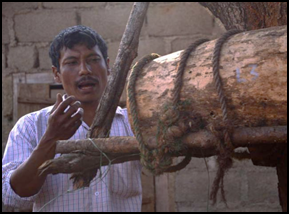
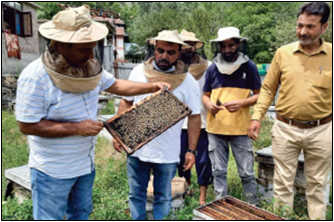
Stories from Meghalaya and Kupwara show how scientific beekeeping is improving livelihoods. In Meghalaya, households are scaling honey production, while in Kupwara, farmers supported by subsidized colonies and processing infrastructure are now producing organic honey at scale and planning for GI certification.
Conclusion
The National Beekeeping and Honey Mission is building a structured beekeeping ecosystem where scientific practices, quality assurance, and market access strengthen rural incomes. The mission contributes directly to agricultural growth and sustainable livelihoods under the banner of the Sweet Revolution.
NBHM – Institutional Structure & Functions
Summary table of levels, key institutions/committees, and their main functions under the National Beekeeping & Honey Mission (NBHM).
| Level | Key Institutions / Committees | Main Functions |
|---|---|---|
| National Level |
|
|
| State Level |
|
|
| District Level |
|
|
| Implementing Agencies / Field Level |
|
|
Important Links
https://www.agriwelfare.gov.in/Documents/HomeWhatsNew/AR_Eng_2024_25.pdf
https://sansad.in/getFile/annex/267/AU2415_c1unCP.pdf?source=pqars
https://nbb.gov.in/Archive/Guidelines.pdf
https://madhukranti.in/NBB/
https://apeda.gov.in/sites/default/files/2025-08/MIC_July_Monthly_dashboard_Honey_260825.pdf
https://www.pib.gov.in/PressReleasePage.aspx?PRID=1787763
https://apeda.gov.in/NaturalHoney
https://www.nabard.org/auth/writereaddata/careernotices/0810180025ADS%20Alappuzha%20edited.pdf
https://www.niti.gov.in/honeyed-shot-arm-aatmanirbhar-bharat
https://megipr.gov.in/docs/Success%20Stories_2.pdf
https://kupwara.nic.in/achievements/success-story-apiculture-sector/
https://static.pib.gov.in/WriteReadData/specificdocs/documents/2025/nov/doc2025112682601.pdf