Indian Army Hosts Chanakya Defence Dialogue 2025
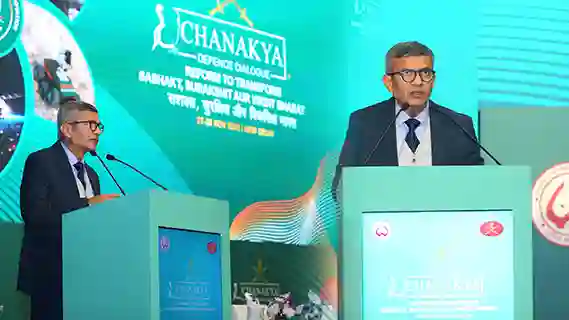
Reform to Transform – Sashakt, Surakshit Aur Viksit Bharat
The Chanakya Defence Dialogue 2025 began today at the Manekshaw Centre in New Delhi, bringing together military leaders, global strategic specialists, diplomats, industry representatives and young researchers. The inaugural session was attended by Smt Droupadi Murmu, Hon’ble President of India, while Gen Upendra Dwivedi, Chief of the Army Staff, delivered the keynote address.
The event, organised by the Indian Army in partnership with the Centre for Land Warfare Studies, focuses on the national vision of Sashakt, Surakshit and Viksit Bharat. It explores India’s security concerns and technological priorities in an increasingly contested international environment.
President Highlights India’s Strategic Outlook
In her special address, the Hon’ble President of India acknowledged the Indian Army’s contribution to strengthening national security and advancing development across border regions. She noted that India’s deterrence approach is rooted in moral clarity and responsible conduct, reflecting the ethos of Vasudhaiva Kutumbakam. She observed that new spheres such as cyber, space and cognitive warfare require forces that are technologically prepared and forward looking. She appreciated efforts by the Army to revise doctrines, modernise organisational structures and invest in human capital, including expanded opportunities for youth and women. She expressed confidence that these measures will support India’s progress towards becoming a Viksit Bharat by 2047.
Army Chief Outlines Transformation Roadmap
In his keynote remarks, General Upendra Dwivedi said the Chanakya Defence Dialogue has developed into an important forum since its launch in 2023, highlighting the Army’s focus on comprehensive transformation. He stated that India operates in a multipolar and turbulent global setting with increasing multidomain conflicts, making it essential for the military to remain decisive and future ready. Referring to the Prime Minister’s 5S vision of Sammaan, Samvad, Sehyog, Samridhi and Suraksha, he detailed the Army’s three-stage transformation plan: HOP 2032 for rapid transition, STEP 2037 for consolidation and JUMP 2047 for developing an integrated next-generation force. He pointed to the progress of ongoing reforms and identified four major elements that will shape the next stage: expanded self-reliance through indigenisation, faster development in critical technologies, organisational adaptation and stronger collaboration among the military, industry and academia. He expressed confidence that CDD 2025 will contribute actionable insights for this trajectory.
Defence Secretary Stresses Self-Reliance
Shri Rajesh Kumar Singh, Defence Secretary, described 2025 as the Ministry of Defence’s Year of Reforms and said defence self-reliance is central to the Viksit Bharat 2047 vision. He noted that 75% of the capital procurement budget has been reserved for domestic industry, with a specific portion dedicated to the private sector, encouraging indigenisation, innovation and the expansion of the defence industrial base. Emphasising the strong GDP multiplier effect of local defence spending and the increase in domestic production and exports, he stated that technological and industrial capability in defence is a top priority for safeguarding national security in a turbulent global setting.
NITI Aayog CEO on Global Transitions
Shri BVR Subrahmanyam, CEO of NITI Aayog, said India’s future will be shaped amid multiple global shifts spanning demographics, economics, technology, climate and culture, which are transforming the world order. He observed that as several advanced economies face ageing populations, Asia will remain the centre of global growth and trade, while climate pressures and advances in technologies such as artificial intelligence influence production, warfare and cognition. He emphasised that India, already one of the world’s leading economies, must take advantage of its demographic opportunity, strengthen democratic institutions and pursue long-term national security and economic strategies grounded in defence modernisation, technological self-reliance and agile partnerships to ensure its rise remains constructive for the global community.
Scientific Perspective on Technological Investment
Prof K Vijay Raghavan, former Principal Scientific Adviser to the Government of India, emphasised the importance of technology in sustaining strategic advantages through three parallel investment stages. For the short term (0-3 years), he recommended agility through startups, academia and retrofitting older platforms with sensors and AI for asymmetric warfare, prioritising workable solutions now over perfect ones later. For the mid-term (3-10 years), he focused on controlling value chains, developing indigenous software for unpredictable systems and ensuring a level playing field for private sector research. He stated that the long term (10-30 years) requires strong investment in basic sciences such as materials, biotechnology and cognitive warfare to avoid dependency, and he advocated establishing a Defence Technology Council to support mission-driven progress towards Viksit Bharat@2047.
Thematic Sessions on Day One
The opening day included three thematic sessions featuring senior policymakers, defence leaders, strategic experts and industry representatives. The discussions addressed a broad set of issues, beginning with Op SINDOOR: A Sovereign Strategic Victory, then Changing Status Quo: Vitalising Defence Reforms, and concluding with Civil–Military Fusion: Drivers for Change. Each session examined current challenges and future directions in national security, defence transformation and India’s strategic orientation.
CDS Reflects on Strategic Challenges
General Anil Chauhan, Chief of Defence Staff, delivered a keynote address highlighting the unpredictable nature of time and warfare, drawing on Chanakya’s teachings. He said technological advances are reducing the influence of geography on strategy and enabling a revolution in military affairs through the convergence of AI, hypersonics, robotics, autonomous systems and sensor-driven battlefield transparency. He observed that geopolitical shifts, diminishing sovereignty, increasing reliance on force and nuclear proliferation indicate a volatile future that requires armed forces to develop doctrines for multi-domain operations. He stressed the importance of intellectual honesty and understanding the adversary, stating that successful commanders apply strategy effectively and prepare soldiers for high-stakes conflicts to secure Viksit Bharat@2047.
Agenda for Day Two
The second day of the Dialogue will include a high-level special session led by the Hon’ble Raksha Mantri, who will announce key initiatives and speak on defence reforms aimed at building a Sashakt, Surakshit aur Viksit Bharat. The day will continue with additional thematic discussions.
Across two days, Chanakya Defence Dialogue 2025 seeks to provide a platform for strategic discussion on India’s future security framework. With guidance from the Hon’ble President of India, Raksha Mantri, senior military leaders, policymakers, global experts and scholars, CDD 2025 reinforces the Indian Army’s commitment to contributing to a strong, secure and developed India. The event reflects that India’s strategic transformation will be shaped by moral clarity, technological capability, expanded self-reliance and a whole-of-nation approach.