PDUNASS Hosts 23rd Session of Reimagining Governance: Discourse for Excellence
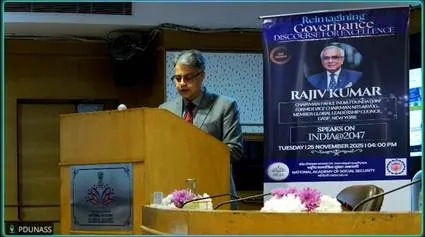
Dr. Rajiv Kumar Highlights Need for Universal Healthcare, Education and District-Based Development
Dr. Rajiv Kumar, former Vice Chairman of NITI Aayog, delivered the keynote address at the 23rd session of Reimagining Governance: Discourse for Excellence (RGDE), commending PDUNASS for establishing a rigorous platform for governance dialogue, which he described as “a forum unmatched across both public and private institutions.”
In his welcome address, Shri Kumar Rohit, Director of PDUNASS, reflected on the purpose of the RGDE initiative, stating that “thought can lead to action, and reflection can lead to change.” He recalled lines cited earlier by the Prime Minister at Ayodhya, describing the “Chariot of Development” powered by valor and strength, yet guided by truth, character, compassion, and balance:
“Suraj dhiraj tehi rath chaka, satya sil drdh dhvaja pataka.
Bal bibek dam parhit ghore, ksama krpa samata raju jore.”
He emphasised that these virtues should guide the transformation of governance in the country.
Dr. Kumar outlined a broad framework for India’s long-term development, referring to policy discussions around regaining India’s historical share of global GDP, joining the OECD, and reaching the World Bank’s high-income threshold of USD 14,000 per-capita income. While recognising the significance of these targets, he stated that they alone cannot define India’s future. He proposed that growth should be reimagined around a Gross Welfare Product, grounded in high levels of human development. Universal free healthcare, universal free education, and high-quality public infrastructure, he said, should serve as foundational pillars, with the public sector creating these assets and private enterprise driving innovation, research, development, and employment.
Reflecting on India’s post-independence progress, Dr. Kumar noted that the country has achieved notable political, social, and economic transformations. He cited the growth in per-capita income from USD 50 in 1947 to nearly USD 3,000 today as evidence of India’s capacity for further achievement, particularly as China’s economic momentum appears to be slowing.
A significant portion of his address focused on the climate emergency, which he described as an existential challenge for Asia. He highlighted the severity of the Asian Brown Cloud, the rapid melting of Himalayan glaciers, rising sea levels, and extensive soil degradation. While acknowledging India’s initiatives in natural farming, carbon sequestration, and climate-aligned agriculture, he stated that adaptation and mitigation alone are insufficient. He proposed an indigenous development model aligned with India’s ecological context rather than replicating approaches that have caused environmental harm elsewhere.
Dr. Kumar also highlighted India’s advancements in Digital Public Infrastructure (DPI), including DIKSHA’s digital learning ecosystem, Bhashini’s multilingual AI capabilities, and the digital health architecture under the Ayushman Bharat Digital Mission. He noted that these platforms are transforming service delivery and attracting international attention from countries seeking inclusive, interoperable, and cost-effective digital solutions.
He called for a shift in the Indian state’s approach from a primarily regulatory role to a promotional and enabling one, particularly at the state government level. Dr. Kumar advocated for a district-based development model, built on district-level GDP baselines, clear administrative KPIs, and collaborative monitoring involving government, industry, academia, and civil society. He stated that this approach would introduce continuous accountability and accelerate local development outcomes.
On labour and social security, he emphasised the need to expand manufacturing, reduce informality, and address youth unemployment. He described India as “a reservoir of extraordinary talent—waiting to be unleashed” and highlighted the challenge for policymakers to unlock this human potential.
Dr. Kumar concluded with a personal reflection from his school days: “Bharat hamara desh hai; iska hum par rin hai; iske liye kuch na kuch kar jaayenge.” He stated that this spirit of responsibility should guide the nation toward 2047.