Vice-President Briefed on Key Initiatives and Achievements of MSME Ministry
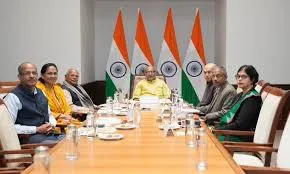
Union Minister for Micro, Small, and Medium Enterprises (MSME), Shri Jitan Ram Manjhi, Minister of State Sushri Shobha Karandlaje, and senior officials of the Ministry met the Vice-President of India, Shri C. P. Radhakrishnan, at Parliament House today.
During the interaction, the Vice-President received an overview of the emergence of the Micro, Small and Medium Enterprises sector as a vibrant and dynamic component of the Indian economy.
He was informed about the sector’s contribution to economic growth, employment generation, entrepreneurship development, empowerment of people, and environmental sustainability.
The briefing included details on the Ministry’s focus on formalizing enterprises through the Udyam Registration Portal to strengthen identity and improve ease of doing business.
The Ministry presented its initiatives aimed at supporting the growth of the MSME sector, including Khadi, Village and Coir industries, with emphasis on credit support, technological assistance, infrastructure development, skill development and training, enhanced competitiveness, and market assistance.
He was updated on major schemes such as PM Vishwakarma, the Credit Guarantee Scheme, the Prime Minister’s Employment Generation Programme (PMEGP), the Micro and Small Enterprises Cluster Development Programme (MSE-CDP), the Public Procurement Policy for MSMEs, and initiatives promoting enterprises owned by women and SC/ST entrepreneurs. The Ministry also outlined its plans aligned with the vision of Viksit Bharat.
The Vice-President acknowledged the Ministry’s efforts to strengthen the MSME sector, noted the increase in budgetary support and credit flow to entrepreneurs, and appreciated the progress of PM Vishwakarma and other schemes in extending benefits across the country.
He highlighted that MSMEs are the second-largest source of employment in India and stressed that the sector, with its strong legacy and significant untapped potential, should be continuously supported through measures such as infrastructure development, skill enhancement, and the establishment of training institutes in economically backward regions.