
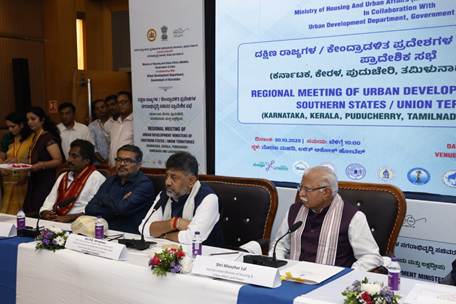
A significant gathering took place in Bengaluru on October 30, 2025, where urban development ministers from southern states and union territories came together to discuss vital aspects of city growth. This event marked the inaugural regional consultation, building on a nationwide session held earlier in New Delhi on July 17, 2025. The Ministry of Housing and Urban Affairs led the initiative in partnership with Karnataka’s urban development department, aiming to address common hurdles and explore new possibilities for urban progress across the region.
Key Participants and Leadership
The meeting saw active involvement from prominent leaders. Union Minister Manohar Lal chaired the discussions, guiding the agenda with a focus on practical solutions. From Karnataka, Deputy Chief Minister D.K. Shivakumar, who oversees Bengaluru’s city development, joined alongside Urban Development and Town Planning Minister Suresha B.S. and Municipal Administration Minister Rahim Khan. Kerala was represented by Local Self Governments, Excise, and Parliamentary Affairs Minister M.B. Rajesh, while Puducherry sent Housing Minister P.R.N. Thirumurugan.
Senior officials from these states and union territories attended, adding depth to the conversations. On the central side, the Secretary of the Ministry of Housing and Urban Affairs, along with the Additional Secretary, Joint Secretary, and Director of the National Institute of Urban Affairs, contributed their expertise. Other high-ranking officers ensured that every viewpoint received proper attention.
Structure of the Discussions
The session unfolded in two main segments to cover ground effectively. The opening part centered on Bengaluru’s specific urban needs and priorities. As a rapidly expanding metropolis, the city faces unique demands in infrastructure, traffic management, and sustainable living. Participants shared insights on how to tailor strategies that fit local conditions while aligning with broader national goals.
Moving to the second segment, the focus shifted to evaluating how various central programs perform in the southern region. Union Minister Manohar Lal led a detailed review of ongoing initiatives. He examined advancements in cleanliness drives, water supply improvements, housing for all, rapid transit systems, and electric bus services. Challenges in execution came under scrutiny, with ministers highlighting bottlenecks like funding delays, coordination issues, and technical hurdles.
Review of Major Central Schemes
One highlight was the progress under the national cleanliness mission. States reported increased participation in waste management and public hygiene efforts, but stressed the need for better technology adoption in smaller towns. Water and sanitation projects received praise for upgrading urban facilities, yet ministers called for faster project approvals to meet growing demands.
Housing initiatives aimed at providing affordable homes to urban poor families showed promising numbers in completions. However, land availability and beneficiary identification remained pain points. Metro rail expansions in cities like Bengaluru and Chennai were discussed, with emphasis on timely funding and integration with other transport modes.
The electric bus program, designed to promote green mobility, gained traction in several areas. Ministers appreciated the push towards eco-friendly public transport but suggested more support for charging infrastructure and operator training. Actionable steps emerged from these talks, including streamlined monitoring mechanisms and targeted technical assistance from the center.
Appreciation and Follow-Up Measures
State representatives expressed gratitude for the central ministry’s hands-on engagement. They valued the direct interaction, which allows for quicker resolution of ground-level problems. To maintain momentum, the ministry has started site inspections and individual video calls with state teams. These steps help track developments in real time and address emerging issues promptly.
Such regional forums will become a regular feature in other parts of India. By bringing ministers together based on geography, the approach uncovers shared concerns, local innovations, and best practices that can be replicated. This peer exchange is expected to speed up the country’s overall shift towards modern, efficient urban centers.
Invitation to National Urban Conclave
All attendees received invitations to a larger event, the National Urban Conclave, set for November 8 and 9, 2025, at Yashobhoomi in New Delhi. This gathering will compile findings from every regional meeting held nationwide. It aims to create a unified strategy for city development, supporting the vision of a developed India by 2047.
The conclave will emphasize building cities that welcome everyone, protect the environment, and compete on the world stage. Themes like inclusive planning, green technologies, and resilient infrastructure will take center stage. By combining regional inputs, the event promises a comprehensive blueprint that states can adapt and implement.
This series of meetings underscores a collaborative spirit between the center and states. With urban populations rising quickly, coordinated efforts are crucial to manage growth without compromising quality of life. Southern states, home to some of India’s busiest hubs, stand to benefit greatly from these targeted discussions.
As cities evolve, initiatives like these ensure that development remains people-centric. From cleaner streets to better homes and smoother commutes, the outcomes will touch millions of lives. The commitment shown in Bengaluru sets a positive tone for similar engagements elsewhere, paving the way for smarter, more livable urban spaces across the nation.
The push for regular regional dialogues reflects an understanding that urban challenges vary by area. What works in the south may inspire the north, and vice versa. This exchange of ideas fosters innovation and accountability, ultimately contributing to a stronger urban India.
With the national conclave on the horizon, excitement builds for the next phase of planning. Stakeholders from government, experts, and possibly private sectors will converge to refine strategies. The goal remains clear: transform cities into engines of economic growth while ensuring sustainability and equity.