
A groundbreaking study from the Indian Institute of Astrophysics (IIA) reveals how supermassive black holes and their cosmic jets play a pivotal role in galaxy evolution, suppressing star formation and regulating galactic growth. Published in The Astrophysical Journal, this research offers new insights into the dynamic interplay between black holes, gas outflows, and the fate of galaxies.
Unveiling the Power of Supermassive Black Holes
At the heart of most galaxies lies a supermassive black hole, millions of times more massive than our Sun. These cosmic giants drive intense radiation and high-speed gas outflows, known as active galactic nuclei (AGN), which significantly influence their host galaxies. The IIA study, utilizing archival data from the Sloan Digital Sky Survey (SDSS) Telescope and the Very Large Array (VLA), analyzed over 500 nearby galaxies to uncover how these forces shape galactic evolution.
Gas Outflows: The Key to Galactic Regulation
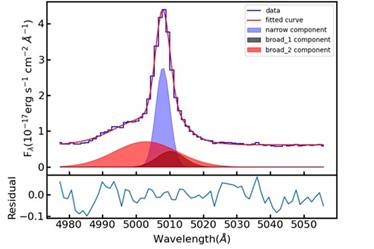
The research highlights that gas outflows, propelled by black hole activity, are critical in regulating star formation. These high-speed streams, reaching speeds of up to 2,000 kilometers per second, can escape a galaxy’s gravitational pull, effectively halting star formation in central regions. This phenomenon, known as negative AGN feedback, explains why some galaxies exhibit remarkably low star-formation rates.
The Role of Cosmic Jets
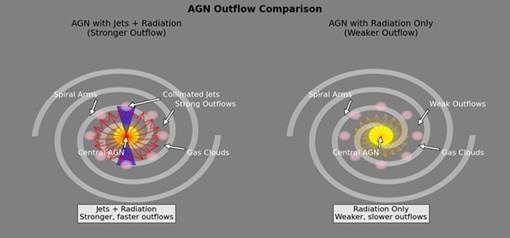
The study found that galaxies with radio jets—narrow beams of relativistic particles traveling near the speed of light—exhibit faster and more energetic outflows. While radiation from the black hole is the primary driver, these jets act as boosters, amplifying the expulsion of gas. Galaxies with radio jets showed outflows in 56% of cases, compared to 25% in those without radio emission.
Multi-Wavelength Insights
By combining optical data from SDSS and radio data from VLA, the researchers gained a comprehensive view of galaxy evolution. Payel Nandi, the lead author and a Ph.D. student at IIA, noted, “Outflows of warm ionized gas are widespread in AGN, and galaxies with radio jets show significantly faster and more energetic outflows.” This multi-wavelength approach underscores the importance of integrated data in understanding cosmic phenomena.
Implications for Galaxy Evolution
The study establishes a strong link between the energy of gas outflows and the luminosity of supermassive black holes, with radio jets enhancing this connection. According to C. S. Stalin, a co-author from IIA, “This study emphasizes how vital it is to combine multi-wavelength data to understand the full picture of galaxy evolution.” The findings also confirm that black hole activity, rather than star formation, drives these powerful winds, reshaping the central regions of galaxies.
A Step Toward Cosmic Understanding
Dhruba J. Saikia, co-author from the Inter-University Centre for Astronomy and Astrophysics, emphasized, “These findings are an important step in understanding the complex inter-relationships between supermassive black holes, radio jets, star formation, and the evolution of their host galaxies.” The research not only deepens our understanding of galaxy formation but also highlights the profound impact of black holes on the universe.
Keyword: Supermassive Black Holes
Meta Description: Discover how supermassive black holes and cosmic jets shape galaxies by suppressing star formation, as revealed by a new study from the Indian Institute of Astrophysics.